

Trust Is the New Digital Currency
In a post-pandemic world, where physical interactions are replaced with screen time and real-time decisions are made in milliseconds, trust has taken on a whole new meaning, especially for banks and credit unions.
Gone are the days when trust was built solely through face-to-face interactions and branch visits. Today, trust lives and dies in the digital space, determined by how institutions collect, manage, and protect sensitive data. For financial institutions handling the most private aspects of consumers’ lives, income, debts, and identity, this isn’t just a tech issue. It’s a brand issue.
How has the definition of trust changed for banks and credit unions in the digital age?
Consumers now equate trust with transparency, control, and security, not just reputation. And while convenience was once king, a new ruler has emerged. Is convenience still king, or has trust overtaken it in customer priorities?
For a growing segment of digitally-savvy users, trust beats speed. They want to know not only what you’re doing with their data but why…and that they have the power to say no.
Transparency & Consent: The Foundation of Trust in Digital Banking
Financial institutions still struggle with transparency, not due to malice, but from legacy systems, siloed data, and unclear communication strategies. Vague language around data use only adds to the confusion.
Most financial institutions are not doing enough to clearly explain their digital policies and practices, mostly based on not having the tools to keep up. Legal disclaimers and fine print don’t count as transparency.
So, what does radical transparency look like in the banking sector?
- Plain language privacy notices.
- Real-time alerts when data is used.
- Dashboard-level visibility into consent and preferences.
Is radical transparency realistic? Yes, but it requires investment in the right tech stack and a mindset shift. Tools like HubSpot help make this possible by enabling:
- Permission-based marketing
- Clear, consistent messaging across channels
- Segmented communications that honor user choices
How can HubSpot help facilitate more transparent communication with customers?
Through customizable forms, email preferences, and CRM-integrated workflows that keep compliance and consent at the forefront, without adding friction to the user experience.
Data Protection & Privacy: From Compliance to Customer Loyalty
For too long, privacy has been seen as an IT or legal concern. But in 2025, it’s a competitive differentiator. The role that data privacy plays in customer loyalty is huge. When customers believe their sensitive information is respected, they're more likely to engage, opt in, and stay.
To shift from a compliance-first to a trust-first mindset, institutions must:
- Use data minimization practices
- Offer granular user controls
- Implement consent-first personalization
How can automation and personalization live in harmony with privacy expectations?
By designing marketing automation workflows in platforms like HubSpot that are triggered only after explicit consent. Every personalized experience must be rooted in voluntary participation, not assumption.
Protection: Security as a Service Experience
Consumers expect banks and credit unions to keep their data safe; that’s table stakes. But how you communicate about data protection is just as important as the protection itself.
What are the expectations consumers now have around cybersecurity and fraud prevention?
They want proactive defense, real-time alerts, and easy-to-understand communication, not fear tactics.
Can banks and credit unions make security feel like an experience enhancer rather than a barrier? Absolutely. Done right, security becomes a confidence booster, not a friction point.
- Use biometric authentication to replace passwords.
- Offer real-time fraud alerts with an educational component.
- Frame protection as part of the customer journey, not an obstacle.
How can financial marketers communicate protection without fearmongering?
By focusing on empowerment. Show consumers how you’re putting them in control of their data and accounts without resorting to scare tactics.
HubSpot Tools for Data Protection, Consent, and Trust-Centered Experiences
When thinking about banks and credit unions and their need to unify marketing, service, and compliance around trust, HubSpot provides the ultimate advantage. HubSpot’s platform enables financial institutions to:
- Track consent at every touchpoint
- Automate privacy-first workflows
- Align service teams with marketing to reduce mixed messages
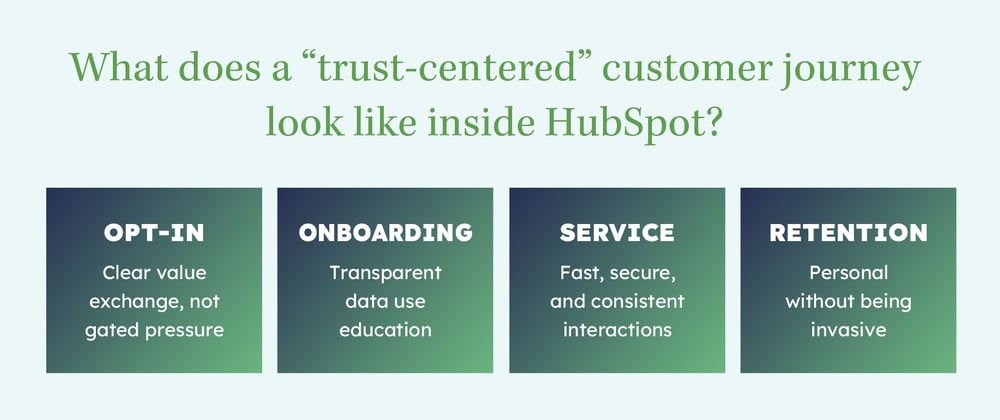
- Create a trust-centered customer journey from lead to loyal member
Use Case Example:
A credit union uses HubSpot’s CRM to:
- Create exclusion segments based on non-marketing criteria
- Trigger onboarding emails based on expressed interest (not assumed intent)
- Monitor opt-out behavior as a signal of trust erosion, not just a lost lead
The Future of Customer Trust: Regulations, Technology & Digital Engagement
Discussing non-negotiables for digital trust going into 2026 and beyond, there are four keys to keep top of mind. First, privacy must be built into digital experiences by design, not tacked on as an afterthought. It should be a foundational principle influencing how products are developed, how data is collected, and how customer journeys are mapped. Second, personalization must be driven by clear and affirmative consent, not inferred behaviors or default settings. Consumers expect relevant experiences, but only when they’ve actively chosen to share their data.
Third, data responsibility must become cross-functional, no longer siloed in IT or compliance departments. Marketing, operations, and service teams all play a role in protecting and respecting customer information. And finally, transparency and trust must be constantly maintained as digital expectations evolve, requiring ongoing education, investment, and adaptation across the organization.

Is your institution ready for a customer base that demands both digital sophistication and ethical clarity?
That’s the new baseline. Trust must be baked into strategy, not just compliance checklists.
Trust Is Earned Every Click of the Way
Trust isn’t a destination; it’s a dynamic, daily investment. From the moment a customer lands on your homepage to every email opened, every piece of data entered, and every transaction made, you’re either building trust or breaking it.
Here’s how to move forward:
- Evaluate your tech stack and data. Are your tools helping you communicate clearly and manage data ethically? How up-to-date is your data?
- Audit your messaging. Does it empower or confuse?
- Review your privacy posture. Are you doing the legal minimum or building brand equity?
In 2026 and beyond, customer trust is no longer a byproduct of good service; it’s the centerpiece of every digital strategy. Financial institutions must treat sensitive data with care, prioritize consent at every touchpoint, and invest in tools that support ethical, transparent engagement. The right technology doesn’t just protect personal data, it builds confidence, ensures compliance with evolving regulations, and turns digital interactions into long-term relationships.
At GreenHouse, we help financial organizations design customer journeys rooted in data protection, clarity, and control. If you're ready to transform trust into measurable business value, let’s start with a conversation. HubSpot enables transparency, privacy, and protection can be built into your customer experience, every step of the way. If you are ready to lead with trust, let GreenHouse help you build a customer journey that earns confidence and keeps it.
