

Why Siloed Systems Hurt Growth
One of the strongest themes from the webinar was how disconnected systems quietly slow institutional growth.
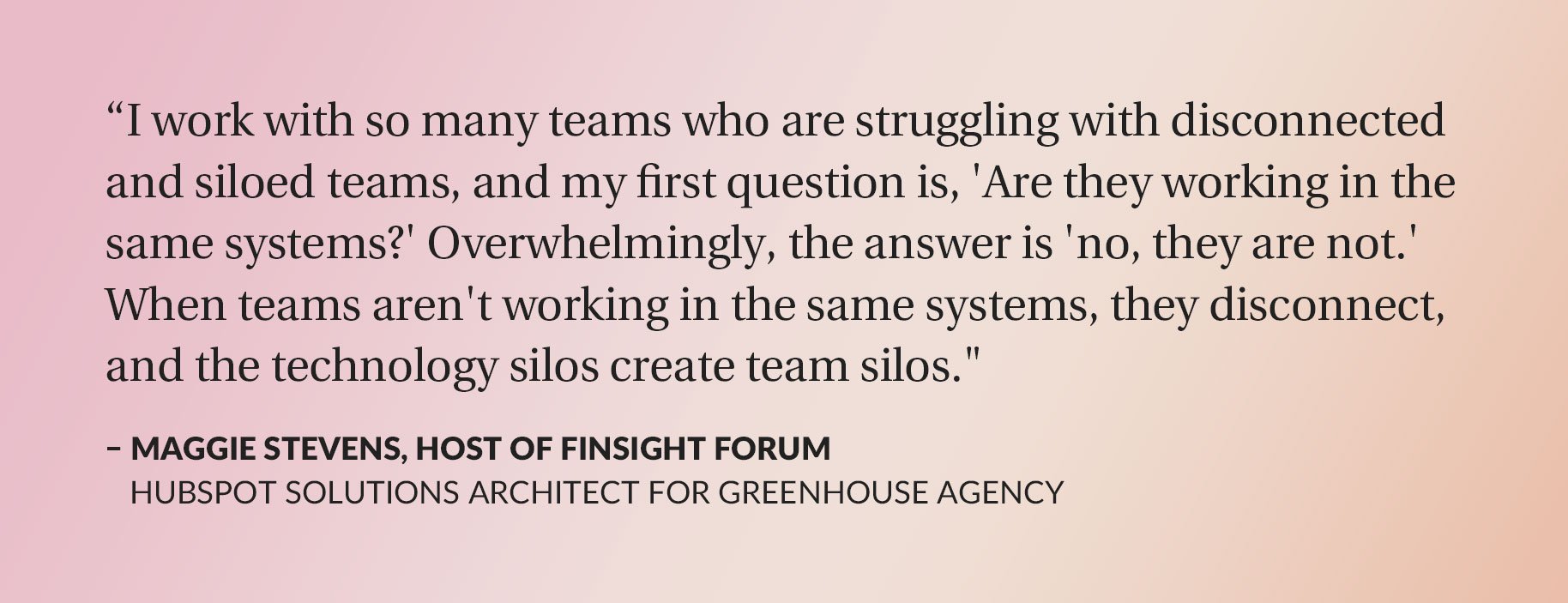
When teams operate on separate platforms, several issues emerge.
Operational inefficiencies
- Duplicate data entry across departments
- Manual reporting processes
- Time spent reconciling inconsistent records
Lost customer insight
- Marketing engagement never reaches sales teams
- Support interactions aren’t visible to relationship managers
- Teams lack a shared activity timeline
Customer experience challenges
- Slower response times
- Inconsistent communications
- Members repeating information to multiple departments
Strategic limitations
- Hard to measure lifecycle ROI
- Marketing attribution becomes incomplete
- Cross-sell opportunities go unnoticed
As speakers noted, the problem usually isn’t a lack of data; it’s a lack of shared visibility.

Moving Beyond Marketing: The Full Hub Strategy
The central takeaway from the session was clear: financial institutions see the greatest success when they deploy multiple HubSpot hubs together.
Each hub plays a distinct role:
Marketing Hub
Supports campaign automation, segmentation, engagement tracking, and lead generation.
Sales Hub
Manages pipelines, tracks relationship activity, automates follow-ups, and routes leads to the correct teams.
Service Hub
Handles customer support workflows, ticketing pipelines, response SLAs, customer feedback, and retention-focused communication.
Individually, each tool provides value. But the real transformation happens when they’re connected, allowing institutions to manage the full customer lifecycle inside a single system.
Real-World Examples from Banks & Credit Unions
The webinar included several practical implementation examples showing how institutions are using HubSpot operationally.

Campaign engagement triggering sales outreach
Leaders Credit Union built automated workflows that:
- Detect when a member starts, but does not complete, an application
- Create follow-up tasks for outbound teams
- Automatically send reminder emails and SMS messages
- Offer meeting scheduling links for assistance
Leads were prioritized based on engagement signals like email clicks, website visits, or ad interactions, helping teams focus on the highest-intent opportunities first.
Customer lifecycle tracking across departments
Another example highlighted how institutions are using shared CRM records to unify customer visibility.
Activity timelines can include:
- Marketing email engagement
- Website page views
- Logged call notes
- Fraud alerts
- Branch interactions
- Support tickets
This allows frontline staff, call center agents, fraud teams, and marketing teams to see the same customer history in one place, improving both personalization and response accuracy.
Service insights feeding marketing and growth strategies
Service Hub implementations also demonstrated operational gains. Think about replacing an expensive legacy ticketing system and moving its entire customer care center into HubSpot, like HomeTrust Bank did.
Through this, a financial institution could implement:
- Separate support pipelines by business line
- Automated routing based on request context
- SLA tracking for different service tiers
- Color-coded ticket prioritization
Support trends and ticket topics now inform marketing messaging, identify recurring customer pain points, and highlight cross-sell opportunities.
Pipeline visibility replacing manual spreadsheets
Business banking teams that previously tracked loan pipelines in individual spreadsheets moved to a shared deal pipeline.
This enabled:
- Unified reporting across regions
- Automatic deal creation from qualified leads
- Attribution tracking from ad click → landing page → lead → deal → closed revenue
- AI-generated pipeline summaries for leadership
Instead of compiling reports manually, teams now access real-time production visibility.
Continue the Conversation
If your financial institution is currently using HubSpot primarily for marketing, now is the time to reassess your broader strategy.
Banks and credit unions across the United States face rising expectations around customer experience, increasing competition across marketing channels, and evolving market trends shaped by digital-first consumers. Simply running campaigns isn’t enough. True impact happens when your entire marketing strategy aligns with sales, service, and operations.
That means evaluating how your marketing team, service leaders, and relationship managers are connected inside one ecosystem. Are your marketing efforts tied directly to pipeline visibility? Can your teams see shared customer data? Are you using data analytics and advanced analytics to measure full lifecycle marketing performance?
When systems operate in silos, marketing activities may generate engagement, but they don’t always translate into measurable growth. However, when marketing, sales, and customer service teams share visibility, institutions can better understand customer segments, anticipate customer needs, and refine their value proposition for every target audience they serve.
A connected approach also unlocks smarter execution:
- Aligning social media, social media marketing, email marketing, and content marketing inside one coordinated marketing campaign
- Leveraging marketing automation to respond instantly to high-intent behaviors
- Using tools like Google Analytics alongside CRM reporting to gain deeper, valuable insights
- Applying predictive analytics and even generative AI to surface opportunities faster
This level of coordination creates a meaningful competitive advantage.
For next steps, consider:
- Watching the full webinar replay
- Connecting with the FinSight Forum organizers
- Joining future sessions to hear additional implementation stories
The most successful financial institutions aren’t just adopting platforms. They’re aligning their operations around them. Now is your turn to go from platform adoption to operational alignment.
