

Most credit union CRM migrations don't fail because of bad software. They fail because of bad preparation.
Most credit union CRM migrations stall not because the platform was wrong, but because the institution wasn't ready for what the move would actually require. Here's a scenario that plays out more often than anyone in this industry likes to admit: A credit union spends six months evaluating platforms, signs a contract, and kicks off implementation with genuine excitement. Eight weeks later, the project is stalled. The data export revealed thousands of duplicate member records that no one knew existed. The integration with their core banking platform isn't working the way the vendor promised. Staff is frustrated, leadership is asking hard questions, and by month three post-launch, half the team has quietly gone back to their spreadsheets.
The platform wasn't the problem. The preparation was.
A CRM migration isn't an IT project. It's a transformation of how your institution knows and serves its members, how you track relationships, personalize outreach, identify opportunities, and deliver on the promise of the member-first model. Treating it like a software swap is where things go wrong.
Before you evaluate vendors, sign a contract, or export a single CSV, you need to answer 10 questions. These are the same questions GHA asks every credit union we work with at the start of an engagement, because what you find shapes everything that comes after.
Why Credit Unions Face Unique Migration Challenges
Before the checklist: a quick word on why credit union migrations are harder than the vendor demos suggest.
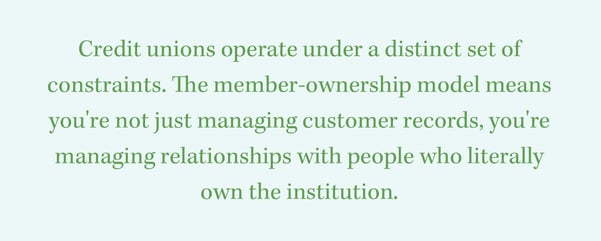
Credit unions operate under a distinct set of constraints. The member-ownership model means you're not just managing customer records, you're managing relationships with people who literally own the institution. The regulatory environment, including NCUA oversight, adds compliance complexity that commercial CRM implementations rarely face. Internal teams are typically lean, which means the people driving a migration process are also running everything else. And unlike fintechs or banks with proprietary infrastructure, most credit unions depend heavily on a small number of core banking platforms with integrations that are notoriously complex and frequently underestimated.
Here's the other challenge: most CRMs were built for commercial sales teams. They're designed around pipelines, opportunities, and deal stages, not around the relationship-driven, service-oriented model that defines how credit unions actually operate. Implementing one of these platforms in a credit union environment without significant customization and planning is like buying equipment designed for a different sport and wondering why it doesn't fit right.
The checklist that follows is built specifically for this environment.
The CRM Migration Checklist for Financial Institutions: 10 Questions to Answer Before You Start
Question 1: Do You Know What Data You Actually Have and How Dirty It Is?
Before a credit union CRM migration begins, conduct a data audit that maps every source containing member data, assesses quality across each system, and identifies what needs to be cleaned, standardized, or reconciled, including the core, any legacy CRM, spreadsheets, loan origination systems, and shared email inboxes.
Most credit unions don't discover the true state of their data until migration begins. That's the worst possible time to find out.
What typically surfaces: duplicate member records created across years of system migrations and manual entry; missing or inconsistent fields (phone numbers in address fields, names in all caps, partial records never completed); data fragmented across multiple systems, the core, a legacy CRM, spreadsheets maintained by individual departments, a loan origination system, even shared email inboxes. Every one of those sources will need to be accounted for.
At GHA, we've seen migrations derailed in week two because nobody audited the source data. That audit is step one, not step five.

Question 2: Is Your Core Banking Integration Mapped Out? (And What That Actually Involves)
Integrating a CRM with a core banking platform like Jack Henry (Symitar), Fiserv, or FIS requires mapping real-time versus batch data flows, understanding API limitations, and confirming who owns the integration build, factors that most CRM vendors understate in their sales process.
This is the most technically complex and most commonly underestimated piece of any credit union CRM migration. Get it wrong, and nothing else works the way it's supposed to.
The core banking integration determines how member data flows between systems: whether account balances and transaction history are visible inside the CRM, whether changes made in one system are reflected in the other, and whether your staff are working from a single source of truth or toggling between disconnected platforms.
The three major players, Fiserv, Jack Henry (including Symitar and Episys), and the various middleware and API layers that sit between systems, each have their own integration approaches, limitations, and quirks. What a vendor calls a "native integration" can mean anything from a real-time bidirectional sync to a nightly CSV export. You need to know exactly what you're getting.
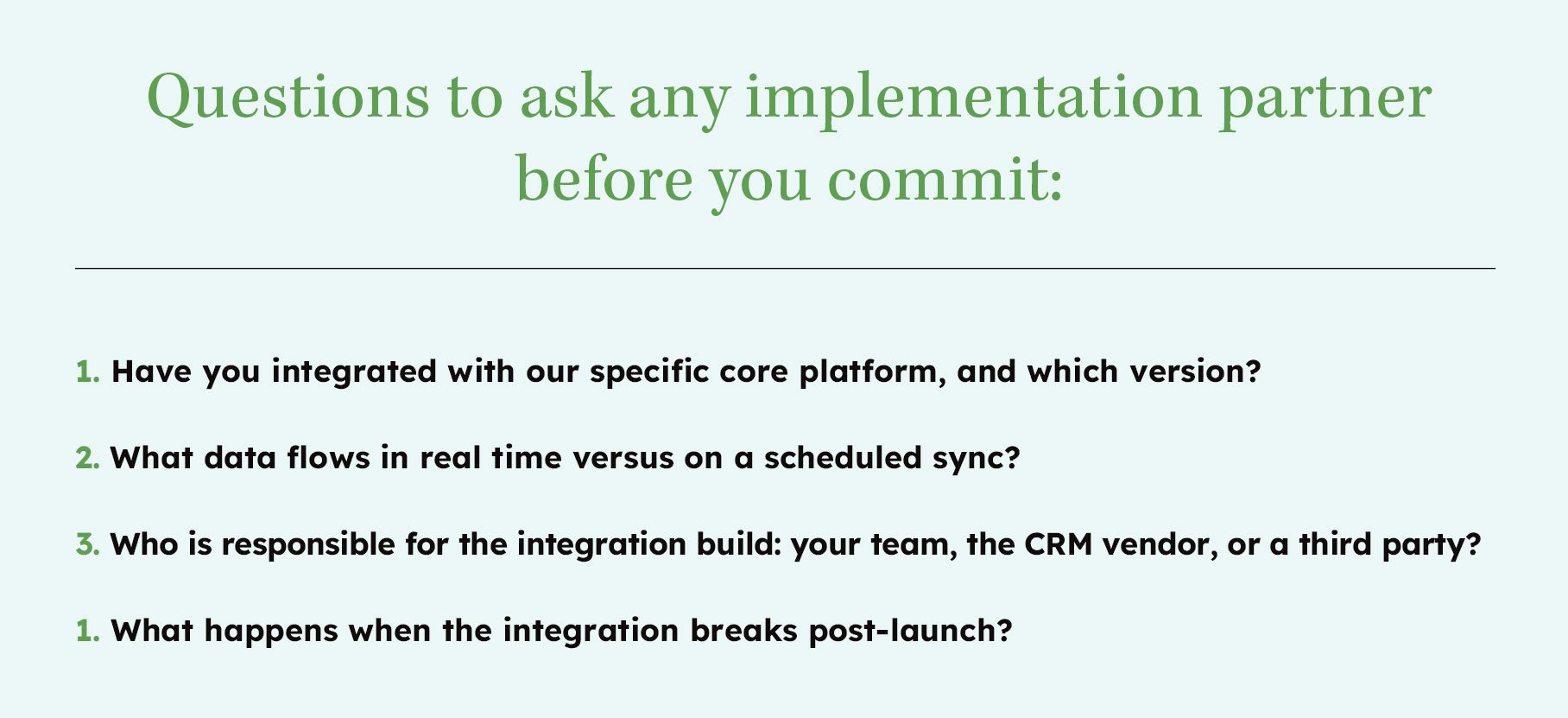
If a partner can't answer these questions clearly, that's a signal worth taking seriously. Real-world CRM integration with lending platforms follows the same rule: the institutions that get results scope from technical discovery, not the sales deck.
Question 3: Have You Defined What "Success" Looks Like in Measurable Terms?
Many migrations have exactly one success criterion: go live. When the platform is live, the project is declared a success, regardless of whether anyone's using it, whether the data is accurate, or whether it's actually improving anything.
This is a trap.
Before migration begins, define what the CRM is supposed to do for your institution and how you'll know if it's doing it. That means specific, measurable KPIs, things like cross-sell conversion rates, member onboarding time (days from application to funded account), and staff adoption at 30, 60, and 90 days post-launch.
Without defined success criteria, you can't evaluate ROI, and you can't make the case internally for the investment you've made. More importantly, without a clear picture of what "better" looks like, you have no way to know whether the migration is actually working. There are good models for how credit unions define and measure CRM ROI worth borrowing from before you set your own.
Question 4: Who Owns This Project Inside Your Organization?
CRM migrations that lack clear internal ownership fail quietly. Decisions don't get made. Deadlines slip. Competing priorities win. The project drifts.
The owner can't be IT alone. A CRM migration touches every department that interacts with members, which, in most credit unions, is all of them. Marketing, operations, retail branch staff, lending, and senior leadership all have a stake in how this platform works. Each needs defined roles and responsibilities from the start.
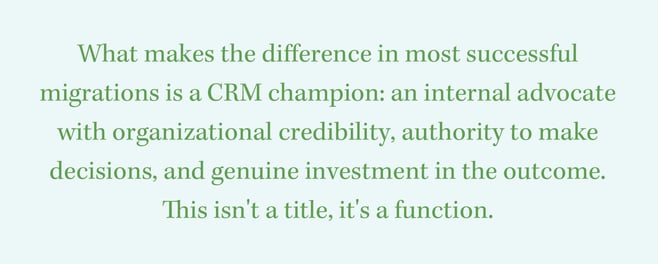
What makes the difference in most successful migrations is a CRM champion: an internal advocate with organizational credibility, authority to make decisions, and genuine investment in the outcome. This isn't a title, it's a function. The champion drives adoption after launch, surfaces issues before they become crises, and keeps the project moving when momentum stalls.
At GHA, we provide a structured RACI framework as part of pre-migration planning. It maps decision rights, accountabilities, and communication pathways across every stakeholder group. But the framework is only as useful as the champion who activates it. Finding and empowering that person is one of the most important things a credit union can do before a migration begins.
Question 5: What Does Your Member Journey Actually Look Like Today?
You can't build a better workflow if you don't understand the current one, including everything that's broken about it.
Before migrating, document the actual member journey as it exists today. Not the ideal version, not the one described in your onboarding brochure, the real one, with all its friction points, workarounds, and gaps. How does a new member get onboarded? What triggers a cross-sell conversation, and who has it? When a member submits a service request, where does it go and how does it get resolved? Where do things fall through the cracks?
The CRM should be designed around that journey, not the other way around. A platform that automates a broken process doesn't fix the process; it just makes the problems happen faster. The member journey documentation you create before migration becomes the blueprint for how the CRM is configured, what automations you build, and what your staff training looks like.
This is where the credit union's digital transformation strategy becomes real. The technology enables the transformation, but only if the transformation is designed first, ideally with an eye on the member experience trends shaping credit union strategy.
Question 6: Have You Audited Your Integrations Beyond the Core?
Core banking gets most of the attention, but it's rarely the only integration that matters.
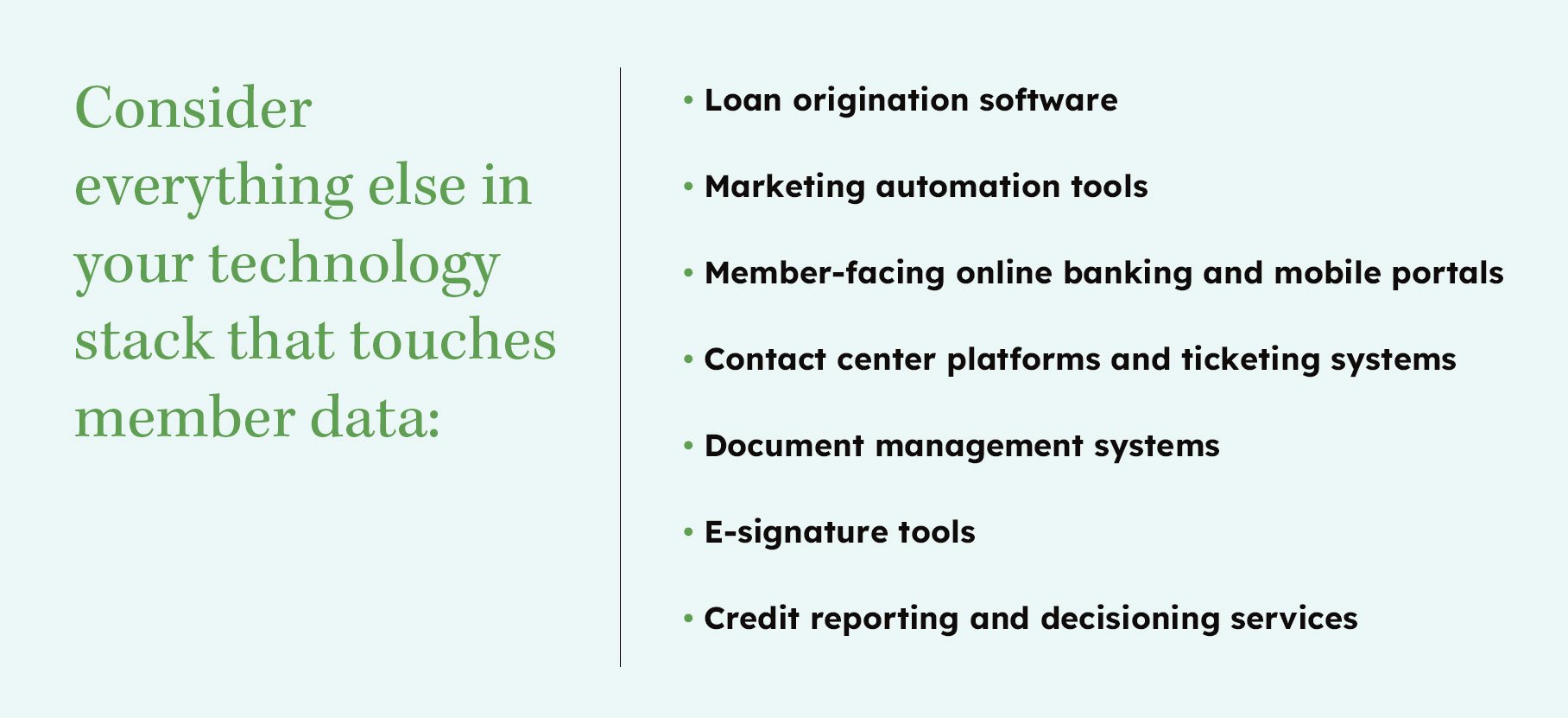
Each integration is a potential point of failure or delay in a migration. Each one needs to be mapped before the project begins, not discovered mid-implementation when you're already under pressure.
Create a complete integration inventory. For each system, document what data flows where, how that flow is managed (API, file transfer, manual process), and what breaks if the connection is disrupted. This map becomes essential for scoping the project accurately and for sequencing the work in a way that doesn't create cascading failures.
Question 7: Does Your Team Have the Capacity to Actually Do This?
This is the question most credit unions answer optimistically, and then struggle with when reality sets in.
CRM migrations require significant internal time and effort. Data preparation, user acceptance testing, staff training, change management, and post-launch support- none of this happens without people. And those people have day jobs that don't pause during implementation.
Many credit unions underestimate the internal lift because implementation is often framed as something that happens to them. Vendors demo the platform, do the configuration work, and hand it over at go-live. The credit union's role sounds passive, "just review and sign off."
It isn't. Successful migrations require active participation from the client team at every stage. The data audit requires people who understand the data. UAT requires people who know how the processes are supposed to work. Training requires people with the credibility to drive adoption. Change management requires people with relationships across the organization.
At GHA, we scope every engagement around the client's real internal capacity. An implementation timeline that assumes a 40-hour internal workweek from a team that's already operating at 110% isn't a plan; it's a setup for a missed deadline and a frustrated staff. Honest capacity assessment upfront protects everyone.
Question 8: What's Your Change Management and Training Plan?
A CRM your staff doesn't use is a CRM that didn't work. Full stop.
Technology adoption doesn't happen automatically. It requires intention, communication, and sustained support, and all of that work needs to start before go-live, not after.
Change management isn't a post-launch activity. It starts before the project does, with a clear answer to the question every staff member will be asking: why are we doing this, and what does it mean for me? If that answer isn't communicated proactively and credibly, people fill the vacuum with their own answers, and those answers are rarely optimistic.
A strong change management and training plan addresses:
- The "why" communicated by leadership, not just IT
- Role-specific training that reflects how each function actually uses the platform
- A feedback loop in the first 90 days to surface issues before they become habits
- Adoption monitoring with actual metrics, not just attendance at training sessions
- A named point of contact for questions and support in the weeks after launch
The platforms that succeed long-term, and there are clear examples of what staff adoption looks like when it works, are the ones where staff feel equipped, not ambushed. That requires planning the human side of the migration with the same rigor as the technical side.
Question 9: Have You Vetted Implementation Partners, Not Just Platforms?
The platform is 40% of the equation. The implementation partner is the other 60%.
A great CRM implemented poorly will underperform. An adequate CRM implemented by a partner who deeply understands your institution's needs can deliver extraordinary results. The platform decision matters, but the partner decision matters more than most credit unions realize when they're deep in a software evaluation process.
What to look for in an implementation partner:
- Financial services experience, not just general CRM consulting, but demonstrated expertise in the regulated, member-centric environment in which credit unions operate
- Credit union-specific knowledge, including familiarity with the operational and compliance considerations that distinguish credit unions from commercial banks
- References from institutions of similar size and complexity
- A clearly defined post-go-live support model, not just a handoff
Red flags:
- Partners who skip or rush the discovery phase
- Partners who recommend a platform before they've asked substantive questions about your institution
- Partners who can't speak fluently about core banking integrations
- Partners whose references don't include financial services, clients
At GHA, this is the question most credit unions ask last. We think it should be asked first, because the right partner shapes the entire engagement, from pre-migration planning through the first year of adoption.
Question 10: Are You Trying to Figure This Out Alone?
Credit unions that enter pre-migration planning without an experienced partner routinely underestimate two things: how long data cleanup takes, and how poorly most core integration scopes hold up once you get into technical discovery.
There's a version of this checklist where a credit union works through all nine questions internally, documents everything carefully, and arrives at migration day genuinely prepared. It happens. More often, though, the institutions that do this well have had someone in their corner during the preparation phase, not a vendor with a product to sell, but an advisor whose job is to surface those gaps before they become project killers.
That distinction matters. A platform vendor's incentive is to get you to contract. A good implementation partner's incentive is to make sure you're ready for the work that comes after, because their reputation depends on what the migration actually produces, not just whether it closes.
The best pre-migration conversations we've seen follow a simple pattern: a credit union walks in thinking they're ready, works through a structured readiness assessment with a knowledgeable partner, and discovers two or three things they didn't know they didn't know. The data audit surfaces a problem. The integration map reveals a gap. The stakeholder conversation uncovers a misalignment between what marketing wants and what IT can support.
None of those discoveries is catastrophic at the planning stage. All of them are expensive mid-implementation. The question isn't whether you need help. It's whether you find the right kind early enough for it to matter.
What Happens When You Skip the Checklist
The consequences of skipping pre-migration planning aren't hypothetical. They're predictable.
Skipping the data audit leads to loss or corruption during migration; no one established data governance rules before the export began. Failed core integration, because the complexity was scoped from a vendor's marketing materials, not a technical evaluation, requires a costly rebuild. Staff abandon the new platform when training is rushed, change management is an afterthought, and no one answers why the change was worth the disruption. Go-live slips, often by months, drag staff time, consultant fees, and organizational frustration with it. And ROI targets get missed, or, more commonly, ROI can't be measured at all, because success was never defined.

None of these outcomes is inevitable. All of them are significantly more likely when the preparation work is skipped.
How GHA Helps Credit Unions Prepare for CRM Migration Before the Hard Work Starts
GHA isn't just an implementation vendor. We're a pre-migration partner, and that distinction matters.
The work that determines whether a CRM migration succeeds happens before most credit unions think the project has started. It's the data audit, the integration mapping, the stakeholder alignment, and the honest assessment of internal capacity. It's unglamorous, methodical, and absolutely critical. The same preparation applies if you're still choosing the right CRM for your credit union.
Our discovery and readiness assessment process, the front end of GHA's CRM implementation services for credit unions, gives credit unions a clear picture of where they stand before they commit to a platform or a timeline. What you get from working with GHA before a smooth migration begins:
- A data audit framework tailored to your source systems
- A complete integration map, including core banking and adjacent platforms
- A stakeholder RACI that defines roles and decision rights across the organization
- A realistic project scope based on your actual internal capacity and constraints
The credit unions that get the most out of projects like these are the ones that do the preparation work no one sees; it's what a well-executed credit union CRM migration looks like from the inside. This CRM data migration checklist isn't a reason to delay; it's a reason to start the right work now.
If your credit union is in the early stages of a CRM migration, or stuck in one that didn't start right, GHA's pre-migration readiness assessment gives you a clear picture of where you stand before you commit to a timeline. Start the conversation.
