

For most businesses, choosing a CRM is a software decision. For a credit union, it's something bigger: it's a decision about how you'll serve members, protect their data, and grow your institution's relationship with the community you were built to serve.
That's what makes CRM implementation different in this industry. You're not just connecting a sales pipeline to a marketing tool; you're integrating member data across core banking systems, navigating NCUA and BSA/AML requirements, and doing all of it with a leaner internal team than most brands ever have to think about.
Which means the software you choose matters less than most vendors want you to believe. What matters more is who helps you put it in place. The right implementation partner can turn a CRM rollout into a foundation for growth. The wrong one can leave you with a half-configured system, frustrated staff, and member data still scattered across five different platforms.
The strongest CRM implementation partners for credit unions combine financial services experience, core banking integration expertise, and a documented post-launch support model.
This guide is a credit union CRM selection guide for anyone building an RFP: it walks through how to evaluate CRM implementation partners specifically through a credit union lens: what to look for, what to avoid, and the questions that separate a partner who understands financial services from one who's learning on your dime.
Why Credit Unions Need a Different Approach
Generic CRM advice doesn't hold up in this industry, for a few reasons:
Member-centric, not customer-centric. Credit unions operate on a relationship and ownership model that most CRM playbooks weren't built for. Your CRM needs to reflect that member relationships often span accounts, loans, and services in ways a typical customer journey doesn't.
Core banking integrations are non-negotiable. A CRM that can't talk cleanly to your core system, whether that's Symitar, Fiserv, or Corelation, creates more manual work than it saves.
Regulatory weight. NCUA guidelines, BSA/AML requirements, and data privacy obligations all shape how member data can be stored, accessed, and used in a CRM. A partner unfamiliar with these constraints can put you at risk without realizing it.
Leaner internal resources. Most credit unions don't have the large dedicated IT and marketing operations teams that bother businesses. A $400 million credit union and a $5 billion one both feel this gap, just at different scales, and your implementation partner needs to be able to fill it, not just hand you a system and disappear.
Signs You're Ready for a CRM Implementation Partner
Some common signals it's time to bring in outside help:
Spreadsheet tracking: Your team is still tracking member interactions in spreadsheets, or in a legacy system that hasn't kept pace with your growth.
Disconnected data silos: Member data lives in disconnected silos; branch staff, loan officers, and the call center all see a different, incomplete picture of the same member.
Board-level pressure: Leadership and the board are pushing for measurable improvements in member experience, retention, or cross-sell performance, and your current tools can't produce the data to support that push.
If any of these sound familiar, the conversation isn't really "do we need a CRM"; it's "who do we trust to implement it right?" And if you haven't started evaluating whether you need a new CRM at all, that's worth working through first.

Key Criteria for Evaluating a CRM Implementation Partner
When you're comparing potential partners, look past the sales pitch and evaluate them on:
Member-centric data model. Does your partner build a data model around your members, or force your members into a default template? A true member-centric implementation ties accounts, loans, and services to one unified relationship record, not a generic contact-and-deal structure borrowed from other businesses' CRM playbooks. This is often the clearest signal of whether a partner understands credit unions or is simply repurposing a standard SaaS rollout.
Credit union / financial services experience. Generic CRM experience isn't the same as experience with member data, loan workflows, and financial services compliance.
Core system integration expertise. Ask specifically which core banking and loan origination systems they've connected to a CRM before, including whether they have direct experience connecting MeridianLink application data to a CRM.
Track record with similarly sized institutions. An implementation approach that works for a $5 billion credit union may not translate to a $400 million one, and vice versa.
Compliance and data security fluency. They should be able to speak knowledgeably about NCUA and BSA/AML considerations without you having to explain the basics.
Change management and training capability. Technology adoption fails at the staff level more often than the technical level.
Post-launch support model. Implementation shouldn't end at go-live. Ask what support looks like 30, 60, and 90 days after launch.
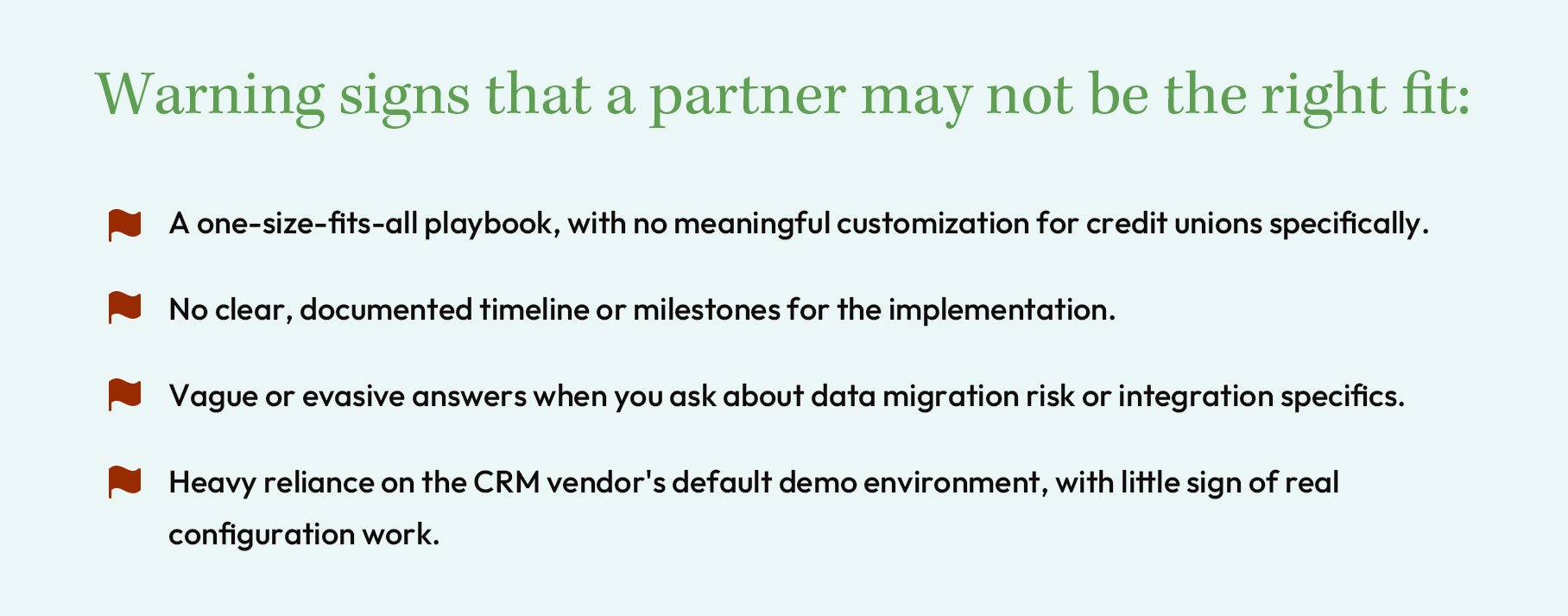
Red Flags to Watch For
Questions to Ask Potential Partners
Bring these into your vendor conversations:
- Have you implemented this CRM with our specific core banking system before?
- What does data migration look like, and how do you minimize risk during the transition?
- What does your first 90 days after go-live look like?
- How do you approach staff training and adoption, not just technical setup?
- Can you share results from a credit union of a similar size to ours?
- How do you handle compliance considerations like NCUA guidelines or BSA/AML during implementation?
- What does ongoing support look like once the initial implementation is complete?
Pay attention not just to the answers, but to how specific and confident they are. Vague answers to direct questions are often the clearest signal of all.
What a Strong Implementation Timeline Looks Like
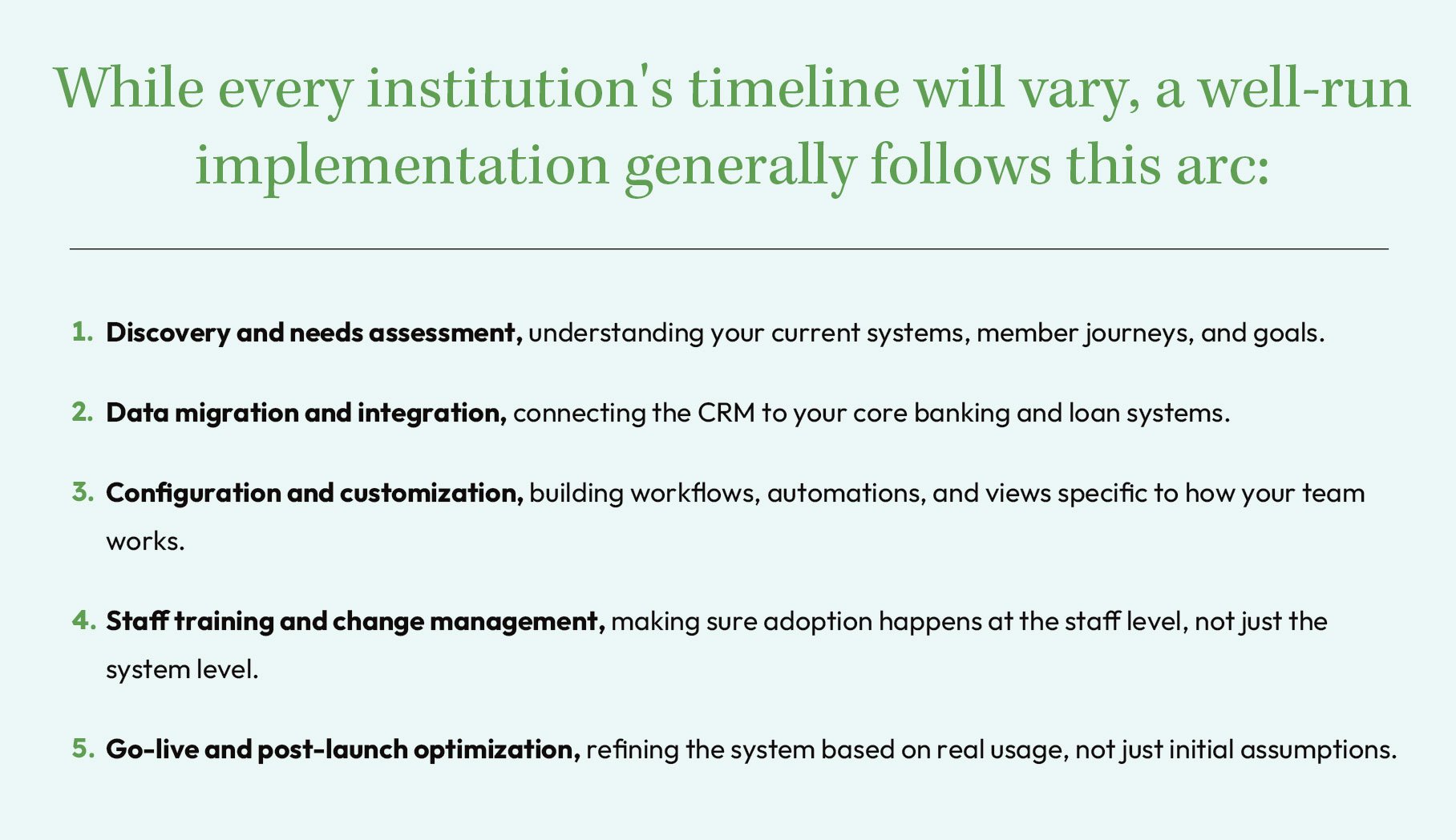
A partner who can walk you through this timeline in specifics, not generalities, is showing you they've done this before. It's also worth having a candid conversation about budgeting for a CRM implementation before the timeline gets locked in, so cost surprises don't derail adoption later.
How to Measure Success After Implementation
Once your CRM is live, the real work is measuring whether it's actually moving the needle. Strong indicators to track include:
- Member engagement and retention metrics
- Staff adoption rates across departments
- Time saved on manual, repetitive processes
- ROI benchmarks specific to credit unions and financial institutions, not generic SaaS averages
If your implementation partner isn't helping you track and interpret these metrics after launch, that's a sign the relationship ended too early.
Choosing a CRM is Only Half the Decision
The partner who implements it is what determines whether that CRM becomes a genuine asset or another underused system your team works around instead of with.

The right partner reduces risk, speeds up time-to-value, and understands the specific realities of serving members in a regulated, relationship-driven industry.
At GreenHouse Agency, this is the work we specialize in: connecting HubSpot to core banking systems like Symitar, Fiserv, and FIS, and loan origination platforms like MeridianLink and Encompass, then building out the marketing, sales, and service workflows that turn that unified data into real member growth. We're also a holder of HubSpot's CRM Implementation Accreditation. If you're evaluating CRM partners and want to talk through your core system integration, data migration timeline, or what a credit union-specific implementation actually looks like, we're happy to walk through it with you.
