

When a HubSpot rollout stalls, the problem usually starts months before go-live. Most CRM implementation services for financial institutions follow the same playbook: configure the portal, migrate the contacts, train the team. For a multi-region bank, that playbook fails.
Eighteen months after go-live, the regional marketing directors still weren't using it. The East region had built their own contact lists in spreadsheets. The West region had 4,200 duplicate records. And the compliance team had flagged three instances where the same customer appeared in HubSpot under different lifecycle stages, assigned to different owners, in different regions.
The bank hadn't bought bad software. They'd built on a bad foundation.
This scenario is more common than most HubSpot partners will admit. For community banks, regional banks, and credit unions managing operations across multiple branches or geographies, the standard HubSpot implementation playbook breaks down. The default object structure doesn't reflect how banks or credit unions actually organize relationships. The governance assumptions built into a typical B2B rollout don't account for regulatory requirements, branch hierarchies, or multi-stakeholder account ownership.
The difference between a HubSpot implementation that actually works, where data is trusted, regional teams adopt it, and it connects to real business outcomes and one that quietly gets abandoned comes down to a single category of decisions: decisions that have to happen before anyone touches the portal.
Why Generic HubSpot Implementations Don't Work for Banks
HubSpot was built primarily for B2B companies with relatively clean contact-to-company relationships. A contact belongs to a company. A deal moves through a pipeline. A lifecycle stage reflects where someone is in a sales or marketing funnel.
That model works well for software companies, professional services firms, and e-commerce businesses. It doesn't map cleanly onto how a bank or credit union operates. What separates a purpose-built financial services implementation from a generic rollout? That distinction goes deeper than most partners acknowledge.
The structural problems start here:
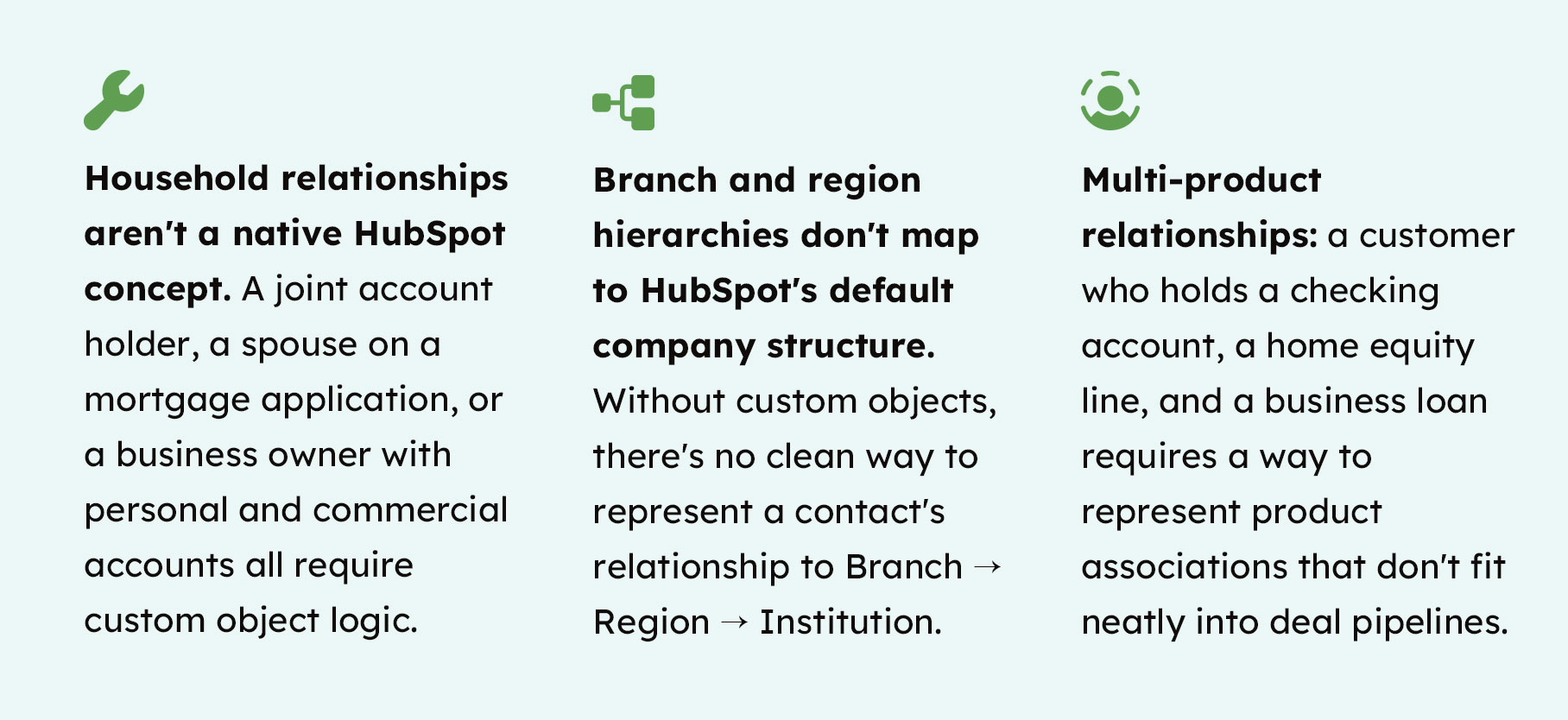
A bank customer isn't just a contact. They're often a member of a household, a signatory on a business account, and a personal checking account holder simultaneously. Who owns that contact record? The branch where they opened their account? Is the relationship manager handling their business banking? The regional marketing team running the mortgage campaign they responded to?
In a multi-region bank or credit union, that question doesn't have an obvious answer, and without a defined answer, each region answers it differently. Eighteen months later, you have the scenario described above.
Add to this the compliance dimension. Financial institutions operate under data governance requirements that don't exist in most industries. Who can access what data, how long it's retained, and how it's used for marketing purposes are not discretionary questions. They have regulatory answers, and your CRM architecture needs to reflect them.
Generic enterprise bank CRM deployment approaches treat these as edge cases to be handled after implementation. They're not. They're the foundation.
The Architecture Decision: Building a Custom HubSpot Banking Data Model
What is a HubSpot banking data model?
A banking data model defines how contacts, companies, deals, and custom objects are structured inside HubSpot to reflect how your institution actually operates, including household relationships, multi-account holders, branch hierarchies, and regional ownership rules. It is designed before configuration begins.
The single most important architecture decision in any HubSpot implementation for banks or credit unions is the data model: how the underlying objects, relationships, and hierarchies are structured before a single contact is imported.
What the Default Model Gets Wrong
Out of the box, HubSpot's CRM assumes a relatively flat relationship structure: contacts are associated with companies, deals are associated with contacts and companies. For a regional bank, this breaks in several places:
What a Custom Banking Data Model Covers
A properly designed HubSpot banking data model defines:
Object hierarchy. Who or what "owns" the contact record at the system level, and how ownership is determined when a customer has relationships with multiple branches, advisors, or regions.
Custom objects. What financial-services-specific entities need to exist in HubSpot that don't exist by default? Common custom objects for banks include: Accounts (financial accounts, distinct from companies), Products (loan types, deposit products), Branches, Advisors/Relationship Managers, and Households.
Association logic. How custom objects relate to each other and to native HubSpot objects. For example: a Household can contain multiple Contacts; a Contact can be associated with multiple Accounts; an Account is associated with a Branch; a Branch belongs to a Region.
Lifecycle stage definitions. What each stage in a bank's contact lifecycle actually means, and who has the authority to move a contact from one stage to another.
For credit unions, the same logic applies, but the terminology shifts. Member instead of customer. Field of membership adds a layer of eligibility logic that doesn't exist in commercial banking. Household associations are equally complex, particularly for joint memberships or business accounts held alongside personal ones.
None of this can be retrofitted cleanly after launch. Once contacts are imported and teams are working in the system, changing the object structure is an expensive, disruptive project. The data model has to be right before configuration begins.
The Governance Framework: The Decision Nobody Wants to Make Until It's Too Late
A well-designed data model tells HubSpot how your institution is structured. A governance framework tells your people how to use it and what happens when the rules aren't followed or edge cases arise.

What should a CRM governance framework for a financial institution include?
A CRM governance framework for a bank or credit union should define: record ownership rules by region and team, required fields and data entry standards, integration touchpoints with core banking systems, naming conventions, lifecycle stage definitions, and a conflict resolution process for data disputes between regions.
For multi-region banks and credit unions, governance is where most implementations quietly fail. Not because the technology breaks, but because nobody defined the rules before teams started using it. For a deeper look at what actually happens when governance isn't defined before go-live [link → pages.ghagency.com/unlock-hubspot-beyond-marketing], the patterns are consistent across institutions.
What Happens Without Governance
When governance isn't defined before go-live, teams fill the vacuum with their own interpretations:
The Northeast region decides that the relationship manager owns the contact record. The Mid-Atlantic region decides that the branch owns it. Both are "right" according to their own logic, and now you have 3,000 contacts with conflicting ownership.
One region uses lifecycle stages to mean "stage in the sales process." Another uses them to mean "product relationship stage." Reports built on lifecycle data are now meaningless.
A new contact comes in who already exists in the system under a slightly different name. Without a defined duplicate resolution process, both records live on indefinitely.
In our experience, these aren't hypothetical problems; they're the pattern we see in almost every remediation engagement we take on at financial institutions that tried to implement without a governance framework.
What a CRM Governance Framework for Financial Institutions Covers
A governance framework for a bank or credit union operating in HubSpot should establish:
Record ownership rules. Which team or role owns a contact record, and under what conditions does ownership transfer? This needs to be defined at the institutional level before regional teams have the opportunity to establish competing norms.
Data entry standards. Required fields on contact creation, naming conventions for contacts and companies, and acceptable formats for key data points. The more ambiguity here, the worse your data quality over time.
Lifecycle stage authority. Who can move a contact to each lifecycle stage, and what criteria define each transition? For banks and credit unions with marketing automation, this has direct downstream consequences for what communications a customer or member receives.
Integration touchpoints. How data flows between HubSpot and other systems, core banking platforms, compliance tools, and loan origination systems, and who owns the integration logic at each touchpoint.
Conflict resolution. A defined process for what happens when two regions claim ownership of the same contact, or when a data entry dispute arises. Without this, conflicts get escalated to IT or simply ignored, and data quality degrades.
Compliance guardrails. What data can be used for marketing purposes, how consent is tracked, and how opt-outs propagate across systems. For banks, this means GLBA compliance and applicable state-level privacy laws. For credit unions, NCUA examination expectations and GLBA requirements both apply. Neither is discretionary, and your CRM architecture needs to reflect them.
The governance framework is a document, not just a conversation. It should be finalized, reviewed by legal and compliance, and formally adopted before the CRM goes live.
Phased Rollout: Why Launching Everywhere at Once Is the Wrong Move
Once the data model is designed and the governance framework is approved, the natural instinct is to stand up the system across all regions simultaneously. It's faster. It avoids the perception of unequal treatment across regions. It feels more efficient.
It's also one of the most reliable ways to ensure the rollout fails.
How long does a phased HubSpot rollout take for a multi-region bank?
A phased multi-region CRM rollout typically involves a 60–90 day pilot phase with one region, followed by a structured refinement period before expansion. This approach allows teams to stress-test the data model and governance framework before rolling out to additional regions, significantly reducing the cost of rework.
Why Phasing Protects the Investment
When you launch a multi-region CRM rollout for banks across all regions simultaneously, every mistake is a system-wide mistake. A data model error affects every contact in the system. A governance gap becomes an institution-wide conflict. A training failure is replicated across every team at once.
A phased rollout contains risk. Problems discovered in the pilot region are fixed before they become problems everywhere. Governance edge cases, the situations nobody anticipated, surface in a controlled environment where they can be resolved methodically.
What the Pilot Phase Should Test
A well-designed pilot isn't just an early launch in one region. It's a structured test of the assumptions built into your data model and governance framework.
During the pilot phase, you should be deliberately stressing:
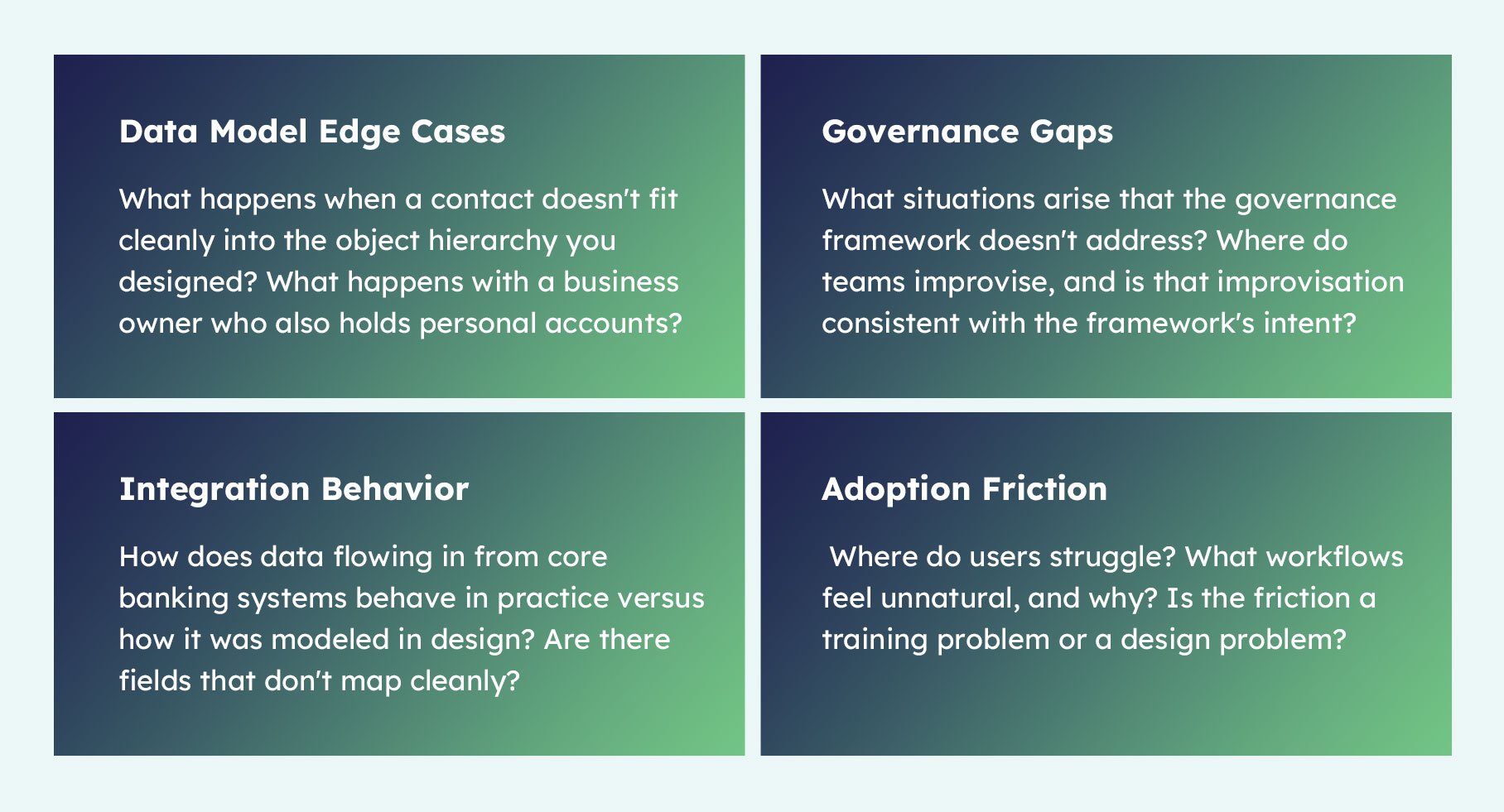
The answers to these questions are what you refine before expanding to additional regions. Fixes are cheap in a pilot. At full scale, they're expensive.
The Integration Question: HubSpot and Core Banking Systems
No HubSpot implementation at a bank or credit union exists in isolation. The CRM has to integrate with whatever core banking system the institution runs, whether that's Jack Henry (including Symitar for credit unions), Fiserv, FIS, or another core platform. And those integrations can't be scoped after go-live. For a concrete example of what a HubSpot integration with a financial services platform looks like in practice, check out this blog. The integration decisions below are where the real complexity lives.
Can HubSpot integrate with core banking systems?
Yes, HubSpot can be integrated with Jack Henry, Symitar, Fiserv, FIS, and other core banking platforms, but the integration architecture must be scoped during the design phase. Key decisions include what data lives in each system, what syncs bidirectionally, and who owns the integration logic.
The Decisions That Have to Be Made Before Configuration
When scoping CRM integration with a core banking system, the critical questions are:
What data lives where? Core banking systems hold the authoritative record for account data, transaction history, and product relationships. HubSpot holds the authoritative record for marketing interactions, contact preferences, and lifecycle stages. The integration design has to define which system wins when there's a conflict, and for what fields.
What syncs, and in which direction? Not everything in your core system should sync to HubSpot, and not everything in HubSpot should write back to your core. Defining the sync scope upfront prevents data bloat, reduces compliance risk, and keeps both systems performing well.
Who owns the integration logic? When the integration behaves unexpectedly, and it will, who resolves it? This is an operational question as much as a technical one, and it needs a defined answer before the first record syncs.
These decisions are considerably harder to make after teams are already using both systems. The integration architecture, like the data model and governance framework, has to be part of the pre-implementation design phase.
What to Look for in a HubSpot Implementation Partner for Financial Services
Not every HubSpot partner has experience implementing for financial institutions. The questions to ask during evaluation aren't about certifications or case studies. They're about architecture.
Ask: Have you designed a custom data model for a bank or credit union before? A partner who has done this work will be able to describe the specific object hierarchy decisions they made, the custom objects they built, and the edge cases they encountered. Vague answers are a red flag; a partner who can't describe what they built hasn't built it.
Ask: What does your governance framework deliverable look like? Financial services CRM implementation specialists should produce a governance framework as a formal deliverable, a documented, reviewable artifact, not a verbal agreement. Ask to see an example. A partner with real experience will have one to share.
Ask: How do you sequence a multi-region rollout? The answer should involve a pilot phase, a defined set of criteria for expanding to additional regions, and a process for incorporating learnings from the pilot. A partner who recommends launching everywhere at once hasn't thought through the risk.
Ask: How have you handled core banking system integrations? They should be able to speak specifically to sync scope, data ownership, conflict resolution, and ideally name the specific platforms they've integrated with.
GreenHouse Agency has earned HubSpot's CRM Implementation Accreditation, one of the clearest external signals that an implementation partner has been evaluated on quality, not just familiarity with the platform. For a closer look at what a multi-region rollout actually looks like for a financial institution, this case study covers the architecture and phasing decisions in detail.
The right partner for an enterprise bank CRM deployment doesn't start with HubSpot configuration. They start with architecture.
The Foundation Determines Everything
Most failed CRM rollouts aren't technology failures. They're planning failures, and by the time the symptoms show up (duplicate records, low adoption, data nobody trusts), the decisions that caused them are 12 months in the past and expensive to undo.
Architecture isn't where the excitement is. But it's where the outcome is decided. The right implementation partner for a multi-region bank or credit union doesn't start with HubSpot. They start with the questions no one else is asking.
A custom data model built for how a bank or credit union actually operates. A governance framework that defines ownership, standards, and conflict resolution before competing norms get established. A phased rollout that contains risk and incorporates learning. Integration architecture is scoped as part of the design, not bolted on after.
None of it is glamorous work. But it's the work that determines whether your HubSpot investment pays off.
If you're working through an implementation scoping decision, that's exactly where we start. Talk to GreenHouse about your implementation architecture.
