

Before your bank touches HubSpot configuration, three foundational decisions, governance, data model, and rollout phasing, will determine whether your CRM deployment unifies your institution or creates new silos.
The failure mode is predictable, and it plays out the same way every time. A bank gets access to HubSpot, assigns a project team, and jumps straight into configuration. Fields get built. Pipelines get created. Workflows start firing. Then, six months in, the regional teams in the Midwest are working a different contact record than the relationship managers in the Southeast. Marketing automation is sending emails to customers who have already been contacted by a banker in another market. Nobody can agree on who "owns" a given relationship, because the CRM was never asked to answer that question.
The institutions that avoid this outcome share one thing in common: they made the hard strategic decisions before they touched a single configuration screen.
This post is written for digital transformation and marketing operations leaders at banks and credit unions evaluating CRM implementation services for financial institutions. The argument is simple. Before configuring HubSpot for a multi-region bank, three decisions determine whether your deployment unifies the institution or creates new silos: who owns shared customer relationships, how your data model maps to how the bank actually works, and in what order regions go live. HubSpot is configurable enough to support a sophisticated multi-region financial institution, but the platform will not make your governance decisions for you. The decisions you make upstream of configuration determine whether your HubSpot CRM becomes the connective tissue of your organization or just another system that technically works while operationally fragmenting your teams.
Why Multi-Region Bank CRM Rollouts Fail, and Where HubSpot Adds Complexity
Multi-region banks are not just bigger banks. They operate with distinct compliance environments, different norms around relationship ownership, and in some cases, data handling and governance obligations that vary by state regulation or charter type. What works for a software company or fintech startup with a flat customer structure and limited compliance obligations doesn't map cleanly onto a financial institution operating across state lines with distinct regulatory requirements in each market.
HubSpot was built for speed of deployment. That is one of its genuine strengths. But speed of deployment is not what a regulated financial institution needs first. The platform's default data model assumes a relatively flat relationship between contacts, companies, and deals. It does not have native concepts for households, relationship hierarchies, product portfolios, or the kind of account structures that bankers actually use to understand their customers.
The result, when institutions skip the strategic work, is a set of failure patterns that compound over time.
Duplicate contacts are the most visible problem. When a customer has relationships in two regions, and both teams are using HubSpot independently, they will create separate records. There is no automatic reconciliation. Over time, you end up with a database full of fragmented records that cannot be trusted, which defeats the core purpose of having a CRM.
The second failure pattern is the absence of a single source of truth for relationship ownership. In a bank, this question matters enormously. If a customer's primary banker in one region is planning a portfolio review conversation, they need to know whether a colleague in another region has already had that conversation or is planning to. A CRM that cannot answer this question is not solving the bank's problem. It is just digitizing the confusion.
The third pattern is marketing automation firing across compliance boundaries. If a customer in a state with specific communication regulations receives an email triggered by a workflow that was built without accounting for those regulations, the bank has a problem that did not exist before the CRM was deployed.
These patterns aren't unique to HubSpot; they show up whenever choosing the right CRM for a financial institution is treated as a procurement decision instead of an architecture decision.
The Governance Questions to Answer Before Configuration Starts
Governance work is not glamorous. It tends to happen in conference rooms with a lot of stakeholders who have competing priorities and limited patience for abstract conversations about data ownership. But skipping it guarantees the failure patterns described above.
These four questions are the core of a CRM governance framework for financial institutions, and every multi-region bank must answer them before HubSpot configuration begins.
1. Who owns a contact when a customer has relationships in multiple regions? There is no universal answer; some institutions assign ownership to the primary relationship manager, some to the highest-value product relationship, and others build a shared-ownership model with defined regional visibility. What matters is that the answer exists, is documented, and is reflected in how the CRM is configured.
2. What constitutes a "deal" or "company" in your institution? A bank's version of a deal might be a loan application, a treasury management opportunity, a new deposit relationship, or a wealth management engagement, and they should not be forced into one pipeline structure without deliberate design. The same applies to the company object: a business banking relationship may span multiple entities and contacts in ways that require a more sophisticated structure.
3. Which teams are allowed to see what? Map your actual organizational structure onto the CRM before building anything: which teams get full cross-regional visibility, which see only their territory, and what happens when a customer crosses regional lines. These questions need written answers before anyone opens the properties editor.
4. How do data retention and audit trail requirements translate to HubSpot? HubSpot has tools that can support regulatory retention and audit-trail requirements, but they do not configure themselves. Compliance teams belong in the architecture conversation, not brought in after launch to review something that cannot easily be changed.
Building a HubSpot Data Model for Financial Institutions
The data model decision is the one that haunts institutions most when it goes wrong. Unlike a governance policy that can be revised, a HubSpot data model that has been in production for a year with thousands of records is extremely difficult to restructure. The costs are not just technical; they are organizational. Teams have built habits around the existing structure, reports have been built against it, and undoing it requires a level of disruption that most organizations will resist.

HubSpot's out-of-the-box objects are Contact, Company, Deal, and Ticket. These four objects are sufficient for a large number of use cases, but they are not sufficient for a multi-region bank without significant augmentation.
Consider what a bank actually needs to represent. A household, which is a grouping of individual contacts who share a financial relationship, has no native equivalent in HubSpot. A customer's product relationships, mortgages, lines of credit, and deposit accounts need to be tracked in HubSpot as relationship context, not as live account data. HubSpot doesn't replace your core banking system, and it doesn't have native access to account balances or transaction history without a core banking integration (Jack Henry, Fiserv, FIS). What it can do is give you a structured place to track relationship stage, ownership, and marketing engagement around those products, which is a different thing, and a genuinely valuable one. The concept of a relationship, which in commercial banking often describes a complex web of business entities, guarantors, and key individuals, requires association logic that the default model does not provide.
A well-designed HubSpot data model for a multi-region bank typically involves custom objects to represent entities like households or product relationships, association labels to define the nature of the relationship between records (rather than just the existence of a link), and property governance rules that prevent teams from using fields inconsistently across regions. There are real examples of how financial institutions have approached data unification in HubSpot, and the pattern is consistent: structure first, then scale.
The architecture work also needs to account for regional variation. If two regions have different definitions of what constitutes a "prospect," and that definition is baked into how pipeline stages are structured, the resulting pipeline data will be incomparable across regions. Standardization at the architecture level, before any team starts entering data, is what makes cross-regional reporting meaningful.
The before-and-after picture is useful here:
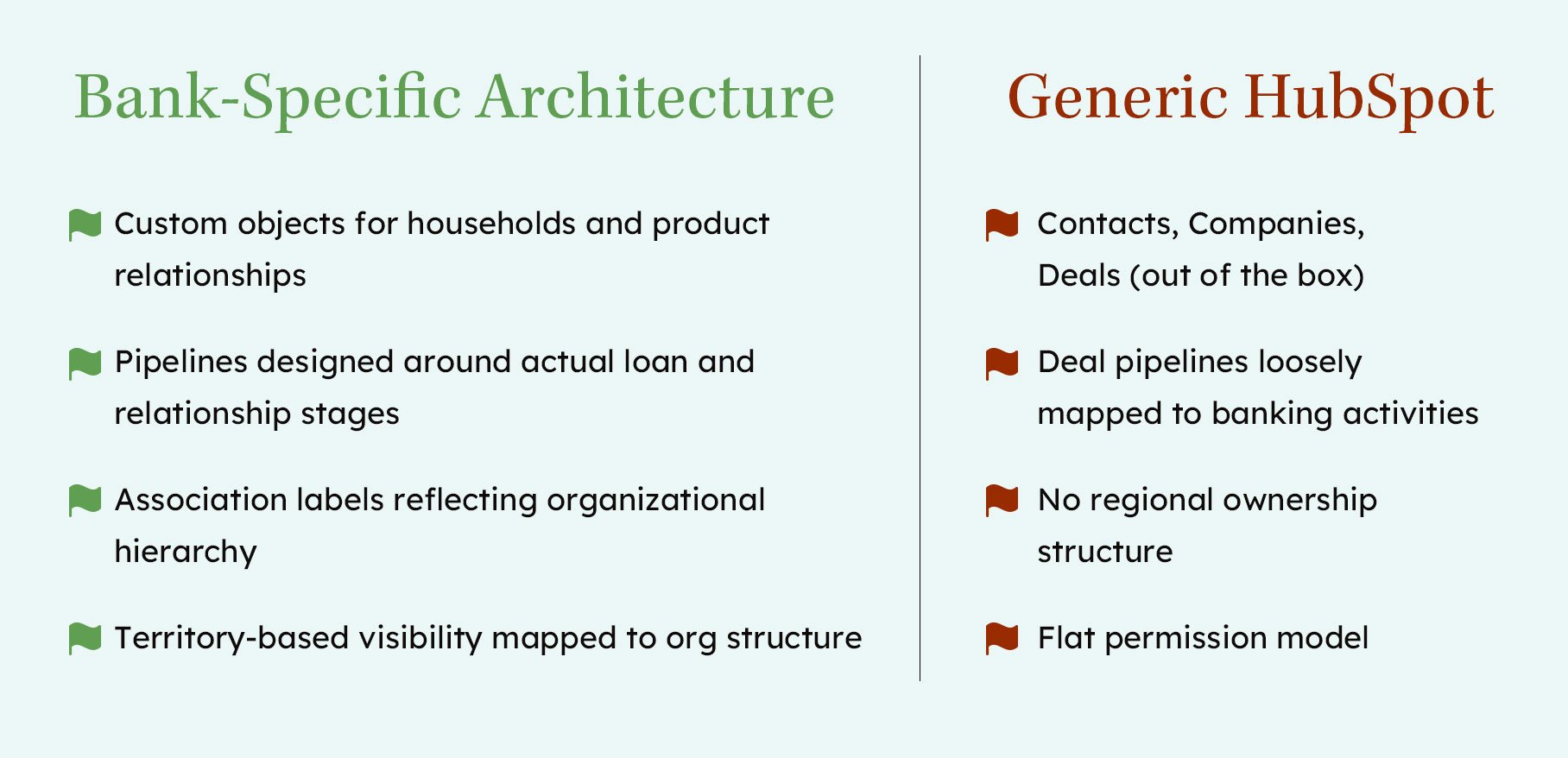
The second model is harder to build and requires more time upfront. It is also the only version that actually solves the problem.
Phasing the Rollout Across Regions
The appeal of a simultaneous multi-region launch is understandable. It feels efficient. It avoids the awkward period where some teams are on the new system, and others are not. It creates a clean line between before and after. In practice, it seldom works.
The coordination requirements for a simultaneous launch scale faster than most teams anticipate. Every region needs to complete data migration, training, and sign-off at the same time. Any delay in one region creates pressure to cut corners in another. The shared infrastructure has to be tested against the full scope of use cases from day one, which means bugs and configuration gaps surface under production conditions rather than in a controlled environment.
A phased approach is more reliable for a multi-region CRM rollout. The basic structure is: launch in a pilot region, validate the data model and governance framework against real usage, get formal sign-off, then expand.
The pilot region should be selected deliberately. Choose a region with engaged leadership, a team that is willing to report problems honestly, and a customer base that is representative of the institution's broader book of business. Do not choose the most complex region for the pilot; the goal is to validate the architecture, not stress-test the entire model simultaneously.
The in-between state, when Region 1 is live and Region 2 is still on legacy systems, requires explicit process design. Who is responsible for maintaining data consistency across the two environments? What happens when a customer in Region 1 also has a relationship in Region 2? The answers to these questions do not have to be elegant; they just have to be documented and followed.
Change management deserves more attention than it typically receives in CRM rollout plans. Regional teams that feel like the CRM is being done to them will find ways to route around it. They will maintain shadow spreadsheets. They will defer data entry. They will use the system in ways that technically comply with requirements while undermining the data quality the institution is trying to achieve. The antidote is early involvement: include regional voices in the governance conversations, give teams genuine input into how their workflows are represented in the data model, and communicate the rationale for decisions rather than just the decisions themselves.
Marketing Automation Comes Last, Not First
When institutions talk about why they want HubSpot, the capabilities that generate the most excitement are usually on the automation side. Email nurture sequences. Lead scoring. Lifecycle workflows. Automated follow-up cadences. These are real capabilities, and they can create meaningful efficiency. They are also the capabilities that should be implemented last.

The logic is straightforward. Automation does not correct for a bad data model; it amplifies the errors in it. If your contact records have duplicate entries, your automated workflows will contact the same person multiple times through different records. If your lead scoring model is built on inconsistently defined properties, the scores it produces will be meaningless. If your lifecycle stages do not reflect actual customer behavior, the workflows that depend on stage transitions will fire at the wrong moments.
"Ready for automation" is a specific condition, not just a feeling that the system has been running for a while. "Ready for automation" means:
- Data model validated against real usage and stable
- Consistent data entry habits established across teams
- Governance framework documented and understood
- Automated workflows reviewed against regional compliance requirements
The sequencing challenge is that automation is often used as the business case for the CRM investment in the first place. If leadership approved the project based on a promise of automated marketing capabilities, telling them that automation is six to twelve months away can create friction. The answer is to be transparent about the sequencing from the beginning and to identify early wins in the foundation phase, reporting capabilities, activity logging, and relationship visibility that demonstrate value before the automation layer is live.
How to Evaluate a HubSpot CRM Implementation Partner for Banks
Most HubSpot implementation partners are competent with the platform. That is not the differentiating variable when you are evaluating partners for a multi-region bank deployment.
Ask to see the governance documentation from a prior engagement. Not a case study, a data model diagram, a property governance framework, a regional rollout plan with sign-off criteria. If a partner can't show you artifacts from a real financial institution engagement, they're describing a capability they haven't demonstrated. Accreditations can help narrow the field. HubSpot's CRM Implementation Accreditation is meaningfully harder to earn than a standard certification, but the artifacts are what prove it.
The other questions worth asking are equally specific. Have they dealt with multi-region compliance complexity? Can they describe specific situations where compliance requirements affected architecture decisions? Do they have experience managing the organizational dynamics of a rollout where different regions are at different stages? A partner who knows what HubSpot actually supports in a regulated financial services environment will have ready answers.
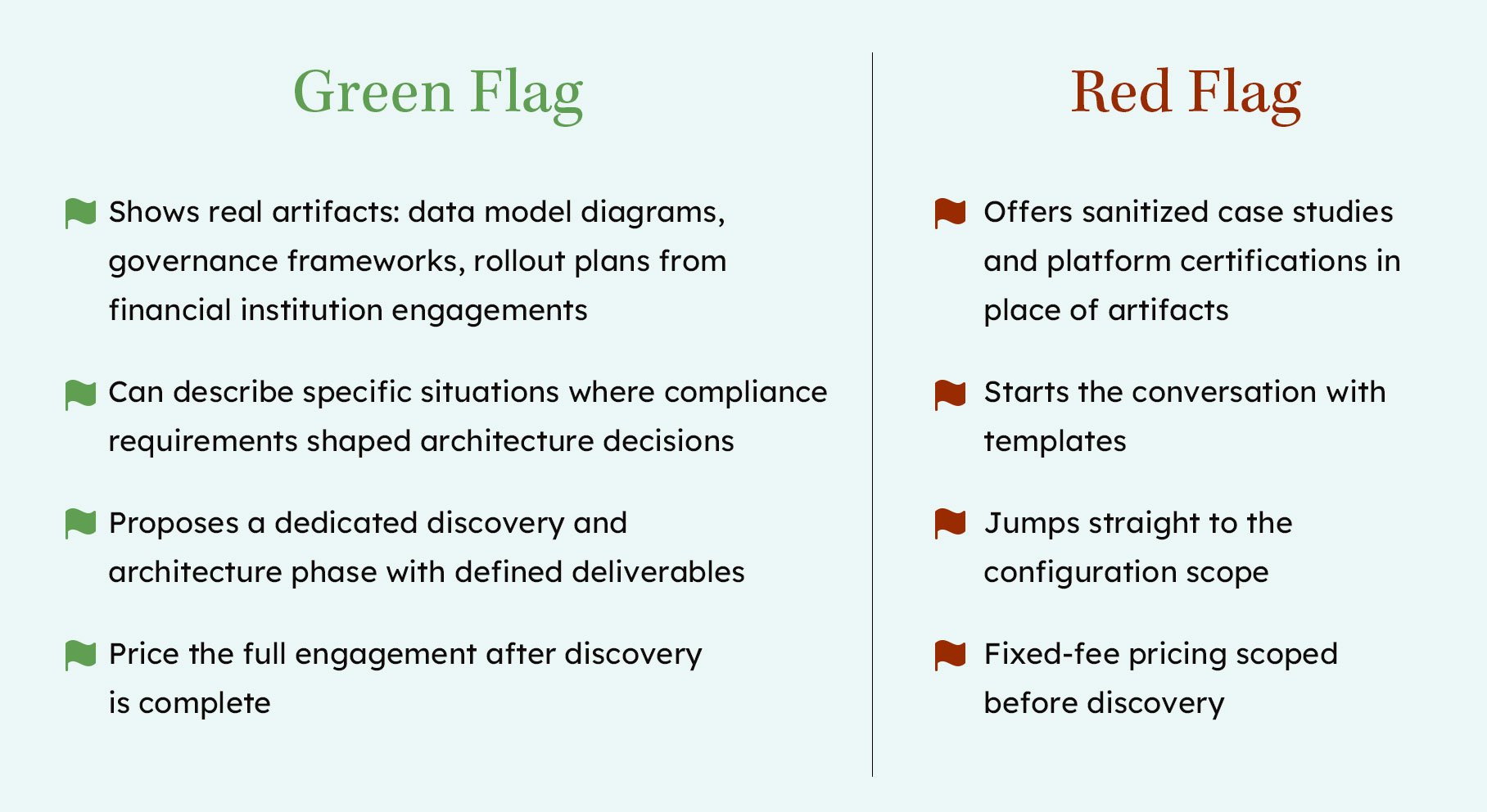
A strong statement of work for a bank CRM engagement should include a dedicated discovery and architecture phase before any configuration begins. The deliverables from that phase should include a documented governance framework, a data model design with rationale, a regional rollout plan with clear sign-off criteria, and an explicit sequencing plan for automation. If a partner is unwilling to structure an engagement this way, they are telling you something about how they plan to approach your project.
The commercial terms also matter. Be cautious about fixed-fee engagements that are scoped before the discovery phase is complete. A partner who prices the full engagement before they understand your institution's data model requirements either knows something you do not or is pricing on assumptions that will not hold.
Configuration is the Easy Part
HubSpot is a capable platform, and most of the technical work involved in building out a CRM for a multi-region bank is well within reach for an experienced implementation team. The decisions that determine success happen earlier. Who owns a shared customer relationship? How do bank-specific concepts map onto the CRM's data model? What is the right sequence for bringing regions onto the system? These are governance and strategy questions, and they require the involvement of compliance leaders, regional business leaders, and technology leaders working together before anyone writes a workflow.
The institutions that get this right do not look dramatically different from those that get it wrong in the first few weeks of a deployment. The difference shows up twelve to eighteen months later, when one institution has a CRM that its teams trust and use as their actual system of record, and the other is trying to figure out which of three contact records reflects the real relationship with one of its best customers.
If you are starting a HubSpot deployment for a multi-region bank, the most important thing you can do in the first month is not to configure anything. It is to answer the governance questions, design the data model, and plan the rollout sequence. The configuration work goes much faster when those decisions have been made. That's where we start.
