

Most banks and credit unions treat marketing automation as a feature they turn on after the CRM is live. Get the platform in place, get people using it, then layer in some automated emails and lead scoring once things settle down.
That sequencing is the problem.
Automation doesn't create value on its own. It amplifies whatever foundation it's built on. Run it against a clean data model with clear governance, and it turns a CRM implementation for financial services into something that actively drives revenue: faster onboarding, sharper cross-sell timing, marketing and sales working off the same picture of every member or customer. Run it against a messy one, and it just automates the mess faster, at scale, with an audit trail showing exactly when things went wrong.
The institutions getting real revenue impact from automation aren't the ones with the most sophisticated tool stack. They're the ones whose CRM implementation was built to support automation from day one, not the ones bolting it on afterward. Here's what that actually looks like, and why the sequencing matters as much as the tool itself.
What Marketing Automation Actually Does for a Financial CRM
Skip past the generic automation pitch, drip campaigns, and lead scoring, and get specific about what it changes in a bank or credit union environment.
It closes the gap between marketing and sales/relationship teams. In most financial institutions, marketing and the frontline don't work off the same data. Marketing sees campaign engagement; loan officers and relationship managers see account activity; nobody sees both at once. Automation, built on a properly integrated CRM, closes that gap. A lead who engages with a rate campaign shows up in the same record that a relationship manager is already looking at, with the same context attached.
It enables personalization based on actual relationship data, not demographic guesses. Generic segmentation ("customers over 45") is a poor substitute for personalization based on what someone actually holds and does: a member approaching the end of a CD term, a customer whose loan is nearing payoff, a household with a mortgage but no auto loan. That level of personalization isn't a marketing automation feature. It's a data availability problem, solved upstream. For a sense of what this looks like in practice, here are real personalization use cases in HubSpot Breeze.
It aligns marketing and sales operationally, not just informationally. Shared visibility isn't just "everyone can see the same dashboard." It means a lead automatically routes to the right person at the right stage, with the right context, instead of getting stuck in a queue or falling through a handoff that nobody owns.
None of this is exotic. It's the standard promise of marketing automation integration. The catch is that none of it works without the foundation underneath it. That's exactly where most implementations run into trouble.
Why Automation Fails Without the Right CRM Foundation
Here's the part most vendor pitches skip: automation built on top of an undefined data model, an inconsistent object structure, or a core banking sync nobody scoped properly doesn't fail loudly. It fails quietly, in ways that are hard to diagnose, because the workflow itself usually isn't the problem. The data underneath it is.
A cross-sell trigger built on product-holding data that's duplicated across records will fire duplicate offers, or worse, fire the wrong offer to the wrong household. An onboarding sequence timed against account-opening data from core banking will misfire if nobody defined sync direction and refresh frequency during integration. A lifecycle campaign meant to respect opt-in status and TCPA/CAN-SPAM disclosure requirements is a compliance problem waiting to surface if consent and communication preferences weren't modeled correctly from the start. 
This is also the honest explanation for why so many financial services CRM vendors' automation tools underperform relative to their demos. The tool isn't the problem. The demo runs on clean, pre-loaded sample data. Your production data, if the data model and governance work wasn't done properly during CRM implementation, isn't clean, and automation doesn't fix that. It exposes it.
This is the same argument we made in 10 Bank CRM Implementation Mistakes (And How to Fix Each One): skipping the data model design phase is the single most consequential mistake in a financial CRM build, and automation is where the consequences show up most visibly. Everything downstream, personalization, cross-sell logic, lifecycle messaging, depends on getting the object structure and governance right first.
What "Doing It Right" Looks Like
The difference isn't whether an institution eventually gets automation. It's when automation gets designed in, relative to the rest of the build.
Bolted on: The CRM goes live. Automation becomes a separate project weeks or months later, built around whatever data structure already exists, gaps and all. Whoever builds it is working around the foundation, not with it.
Designed in: Automation triggers, personalization logic, and lifecycle stages get considered during the data model and governance phase of the implementation itself, before a single workflow goes live. The object structure is built knowing what it needs to support downstream. Institutions that get this sequencing right see it show up in the numbers: a 141% lift in card activation from getting the sequencing right is one example from our own client work.
In practice, that distinction shows up in a few concrete places:
Onboarding sequences triggered by real account-opening events, synced from the core banking system, rather than a generic "welcome to the bank" drip that fires on a signup form regardless of what actually happened.
Lifecycle campaigns based on relationship milestones, a loan approaching payoff, a CD nearing maturity, a member crossing an account-tenure threshold, rather than generic time-based sequences that ignore where someone actually sits in their relationship with the institution.
Cross-sell suggestions driven by actual product-holding data. A household with a mortgage and no auto loan is a real signal. A demographic segment guessing at the same thing is not. The difference is whether the underlying object structure captures product relationships cleanly enough for automation to trigger off them reliably.
None of these are advanced automation techniques. They're standard use cases that simply don't work reliably without the data architecture to support them, which is why the sequencing (foundation first, automation second) matters more than the sophistication of the automation itself.
Special Considerations for Credit Unions and Multi-Region Institutions
Credit union CRM builds carry their own version of this problem. Member-first language and workflows, not customer or prospect framing, need to be built into the automation logic itself. Smaller marketing teams typically need more leverage per person from automation, which raises the cost of getting the foundation wrong.
Multi-region institutions face a related but different challenge: keeping automation logic consistent across branches or regions while still allowing for local nuance, regional rate promotions, and community events, without letting each region build its own conflicting version of the same workflow. That's a governance problem before it's an automation problem. Without a shared framework, a multi-region CRM deployment ends up with as many versions of "onboarding" as it has regions, each drifting further from the others over time. Getting this right matters more every year; here's what member experience expectations look like heading into 2026.
If you're evaluating banking CRM partners or financial services CRM vendors for an enterprise CRM implementation, this is worth asking about directly: not whether their platform can support automation most can, but whether their implementation approach designs automation and governance in from the start, or treats it as a phase-two conversation.
A Quick Self-Check
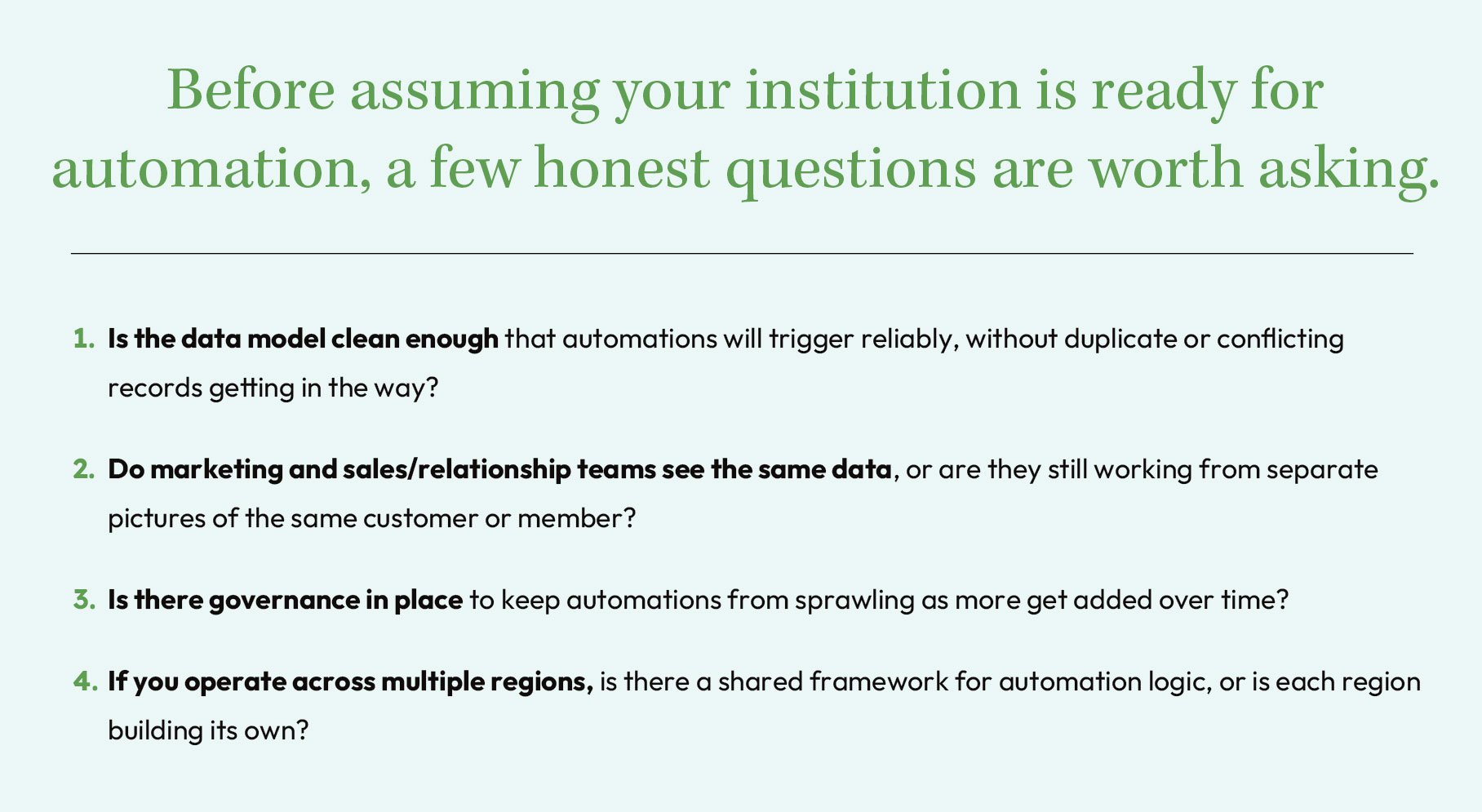
If the honest answer to more than one of these is "not really," that's not a reason to avoid automation. It's a signal about where the actual work needs to happen first.
The Real Takeaway
Automation is a multiplier, not a fix. It makes a well-built CRM implementation more valuable, and it makes a poorly built one more chaotic, faster. The institutions treating it as a bolt-on feature are optimizing the wrong variable.
At GreenHouse Agency, this is why automation isn't a separate engagement tacked onto a finished CRM build. It's part of the same data model and governance work we do from day one, connecting HubSpot to core banking and loan origination systems, and designing the object structure to support the automation an institution actually needs, not just the automation a demo makes look easy. If you're evaluating what a CRM implementation for financial services should look like when automation is part of the plan from the start, we're happy to walk through it.
