

Credit unions have always had a structural advantage: they're member-owned, relationship-first by design. The challenge today isn't the philosophy, it's the execution.
How do you deliver the personal touch your charter promises when your team is stretched across hundreds or thousands of member touchpoints?
AI video personalization for credit unions is emerging as a practical answer. It allows teams to scale communication without losing the human presence that makes members feel recognized.
In a recent webinar, GreenHouse Agency and Vidyard dug into exactly how credit union teams are making this work in practice. What follows is the framework we covered, with room for your team to apply it to your own member journey.
The Personalization Gap in Member Communication
For years, personalization meant inserting a first name into an email and calling it done. That worked, for a while. Today's members expect more. Their baseline is shaped by the tools they use every day: streaming recommendations, real-time alerts, and highly relevant digital experiences.
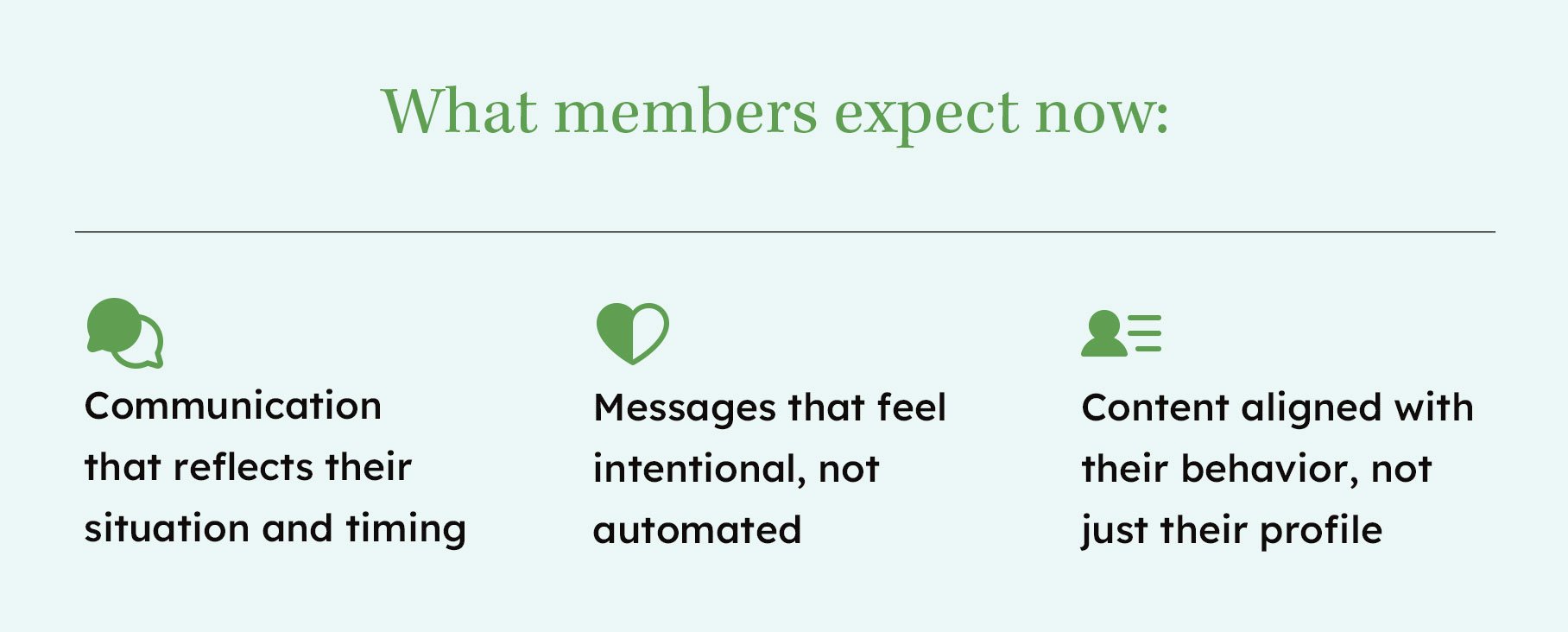
The gap is operational. Delivering that level of relevance manually doesn’t scale.
From Crawl → Walk → Run: Where AI Video Fits
The crawl-walk-run framework still holds up; it just needs to be grounded in how credit union teams actually operate.
Crawl: Foundational Personalization
Segmentation by member type or tenure. Basic automation: onboarding emails, loan reminders, anniversary triggers. In HubSpot, this looks like lifecycle stage-based workflows and simple list segmentation. Useful, but still broad.
Walk: Behavior-Based Engagement
Messages triggered by actions: a member revisits a product page, starts an application, or engages with a campaign. HubSpot's behavioral triggers handle this well, but the message format is still typically email or SMS. More responsive, but still limited by format.
Run: AI Video Personalization at Scale
This is where communication starts to feel human again, without requiring manual effort for every touchpoint.
AI video turns one message into many, delivered with a consistent face and voice, tailored at the moment it matters. Introducing the crawl, walk, run concept, the recent webinar tracked this journey for financial institutions.
"Credit unions and financial institutions today are at very different points in their automation journey. Some teams are still sending broadcast emails at a scheduled time that works for their internal teams, which is fine because we have to start somewhere. Some of you are just starting to build out HubSpot workflows and leveraging campaigns. Others have more sophisticated systems in place and are now wondering how to evolve them responsibly with AI without losing compliance, consistency, or the personal touch that defines your brand."
What Is AI Video Personalization?
AI video personalization combines a lifelike digital avatar (trained on a real person's face and voice) with dynamic CRM data to deliver messages that feel individually recorded. A credit union team records a short video once; the platform personalizes and delivers it at scale based on member behavior, lifecycle stage, or product interest.
How does AI video personalization work for credit unions?
Tools like Vidyard AI Avatars let credit union teams create personalized video at scale, generating a digital avatar from a short training clip, then dynamically inserting member data at delivery.
- Record a short video once to create your avatar
- Write a script or template
- Personalize delivery using CRM data like lifecycle stage, product interest, or engagement history
For credit unions with deeper integrations, this data layer can expand. But even standard CRM data creates meaningful lift.
When referencing the goal and simplicity of Vidyard, co-host Dan Weckend said,
"We're here to support financial institutions in communicating more clearly across the entire member journey. From simple onboarding videos to personalized, AI-generated videos at scale, we're deeply integrated into HubSpot, so your compliance teams can stay in control and get your workflows getting smarter over time."
What AI Video Actually Does for Credit Union Marketing Teams
The value of AI video isn’t abstract; it shows up in very specific moments.
1. Scale Without Losing the Human Touch
Your loan officer closes an auto loan. Thirty days later, that member should hear about a home equity product, but no one has time to record that follow-up individually. With an AI avatar trained on that loan officer's face and voice, that message can be delivered automatically, without feeling automated.
In the cross-sell workflows we've built for credit union clients in HubSpot, this is consistently where teams see the sharpest drop in manual effort, and the clearest signal of whether a member is likely to re-engage. The member sees a familiar face. Your team gets time back. You want to create automations that enhance the member experience, not complicate it. Vidyard's VP of Partnerships, Dan Weckend, discussed this process in the webinar.
"The goal is not to automate everything. It's to identify a few key moments in your members' or customers' journey, and make them feel consistent. As we've said, this could be onboarding. This could be an anniversary, it could be a cross-sell opportunity. If your automation is confusing your team or generating complaints. Definitely not working. That's a sign that you need to pause at the crawl stage and not proceed. We want you to pause here and make sure your team understands what's happening and that the feedback. And the outcomes you're trying to motivate are happening. The goal at this stage is invisible infrastructure. Workflows that just work every time for every member."
2. Increase Engagement at Key Moments
Most onboarding and follow-up emails get ignored because they feel generic. A personalized video, delivered when a member takes action, changes that.
Instead of a static reminder, the member sees a person explaining what to do next, based on what they just did. In our experience, that shift from a static email to a relevant video reliably changes whether a member takes the next step. We've seen it move the needle on card activation, onboarding completion, and application follow-through.
3. Keep Messaging Consistent Across a Lean Team
In most credit unions, a small team is responsible for a wide range of communications.
AI video helps standardize high-performing messaging, while still allowing for personalization at delivery.
That means:
- Clear, consistent explanations of products
- Fewer gaps between departments
- Easier alignment with compliance requirements
4. Reduce Manual Work Without Reducing Quality
Recording individual videos for every member interaction isn't realistic. AI video removes that constraint.
Instead of spending time producing content, teams can focus on improving timing, messaging, and results, where the real gains happen.
Real-World Use Cases for Credit Unions
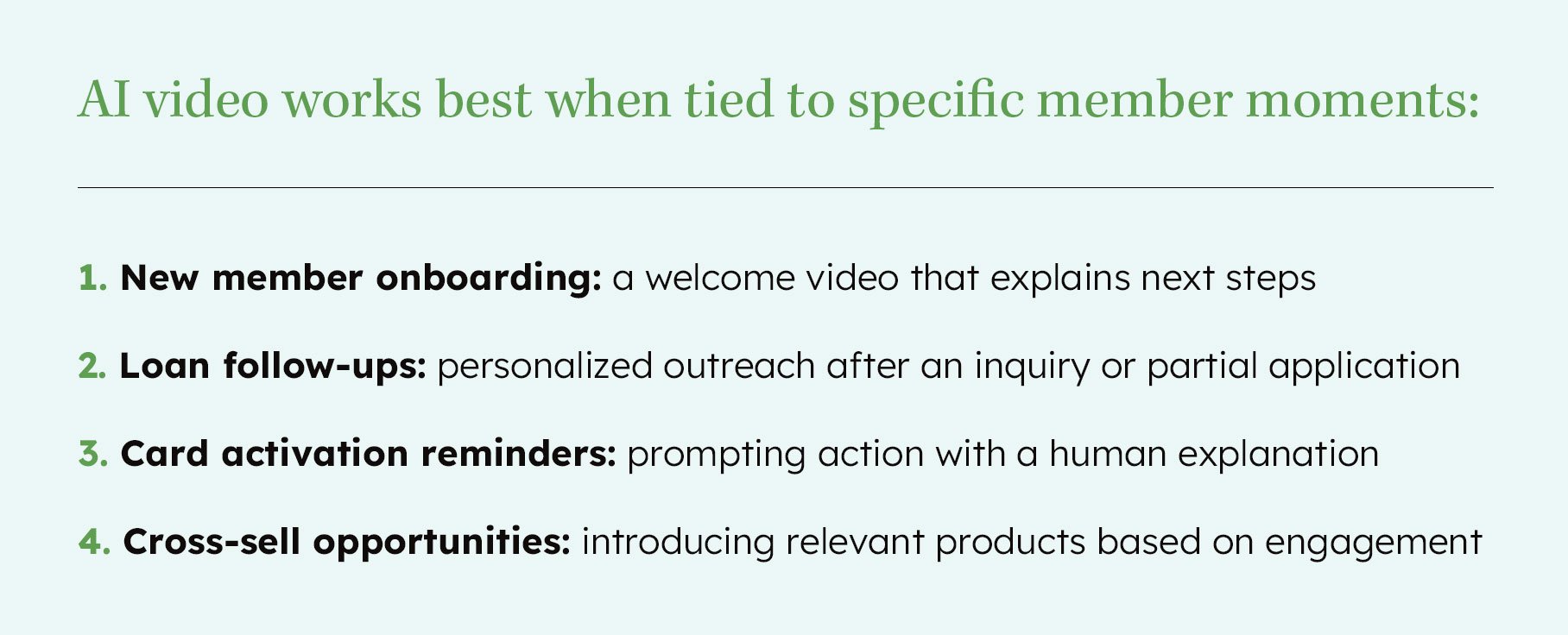
The onboarding use case is often the easiest place to start, and the fastest to show impact.
Overcoming Common Concerns
Will this feel impersonal?
No, because it's built from real human input. The face and voice are familiar. The message is what scales.
The concern usually comes from imagining a robotic voiceover reading a template. That's not what this is. The avatar is trained on an actual person: your loan officer, your member services lead, someone your members may have met in a branch or seen in a previous email. When the message arrives, it looks and sounds like that person recorded it for them. What's automated is the timing and the data layer, not the human presence.
The members most likely to notice the difference are the ones who were already getting nothing. A generic email sent three weeks late is far more impersonal than a relevant video delivered the same day they took an action.
Is implementation complex?
Not with tools designed to integrate into existing CRM and marketing platforms. This extends what you already use; it doesn’t replace it.
If you're already running HubSpot with lifecycle stages and behavioral triggers, the infrastructure for this is largely in place. You're not rebuilding your stack. You're adding a delivery layer on top of workflows that already exist. The heaviest lift is usually the first avatar recording and getting your team aligned on which use case to pilot. After that, the logic is the same as any other automated touchpoint: trigger, personalize, send.
Where implementations get complicated is when teams try to do too much too fast. One use case, fully mapped and measured, is a better foundation than five use cases running on assumptions.
Do members trust AI-generated communication?
Trust comes from relevance. When the message is timely and useful, the format becomes secondary.
Members aren't asking whether a video was AI-generated. They're asking whether it's worth their time. A message that arrives the day after they started a loan application, references exactly where they left off, and tells them what to do next. That message gets engaged with. A broadcast email sent to everyone who touched the loan page in the last 90 days doesn't, regardless of how it was produced.
That said, transparency matters in financial services more than most industries. You don't need a disclaimer on every video, but your communication strategy should reflect your institution's values. Members who trust your credit union extend that trust to the tools you use. Members who don't, won't be won over by production quality alone.

What about compliance review for AI-generated video content?
This is a legitimate concern, and one credit union teams are right to raise early. AI-generated video content should go through the same review process as any other member-facing communication: reviewed for accuracy, approved for channel, and archived per your institution's retention policy. The content itself is still written and approved by your team; the avatar is a delivery mechanism, not an autonomous communicator. Start with low-risk use cases like onboarding and card activation, where messaging is largely standardized, and build a review workflow before expanding to product-specific or rate-sensitive content.
This key quote from the webinar says it best,
"Compliance isn't an obstacle to automation. It's a design constraint you build around."
How to Get Started with the Crawl-Walk-Run Model
You don’t need a full transformation to begin.
Step 1: Audit (Crawl)
Understand what data you're already using, and where communication doesn't reflect it. If your HubSpot CRM already has lifecycle stages and product interest data populated, you're closer to this than you might think.
Step 2: Automate (Walk)
Identify key member moments that still receive generic messaging and build behavioral triggers around them. A member who starts a loan application and doesn't finish is a candidate. So is a member who visits a product page three times in a week.
Step 3: Pilot AI Video (Run)
Start with one use case: onboarding or application follow-up. Measure engagement and iterate. One pilot is enough to prove whether this works in your environment.
Where Member Communication Is Headed
AI-powered personalization is moving from pilot project to baseline expectation, and credit unions that wait for others to validate it will always be a step behind.
What that looks like in practice:
- Workflows that automatically surface a HELOC offer when a member visits that page twice in the same week
- Multilingual outreach for underserved communities that credit unions are actually chartered to serve
- Automated sequences that feel like they came from your branch manager, not your marketing stack
The advantage won’t come from bigger teams. It will come from better execution.
The Next Step
Want to see the full webinar? GreenHouse Agency and Vidyard covered the full crawl-walk-run framework live, including a walkthrough of how this fits inside a HubSpot workflow. Reach out to us to learn more about the webinar and the key takeaways.
If you're already using HubSpot and want to understand how AI video fits into your current setup, that's the place to start. GreenHouse Agency works with credit unions to map tools like Vidyard into existing HubSpot workflows, so personalization becomes something your team can actually run, not just plan. That typically starts with a workflow mapping conversation: where your current member touchpoints are, where the gaps are, and where a video layer would have the most impact before you commit to a platform or a build.
