

Financial institutions are sitting on a conversion problem.
Prospects are checking rates, running calculators, and revisiting product pages. The intent signals are there. But somewhere between curiosity and completed application, they disappear. This gap between interest and action is one of the most significant missed revenue opportunities in financial services today. Personalization for financial institutions is how that gap gets closed, not by adding more touchpoints, but by responding to what members and customers are already signaling through their behavior.
Credit unions and banks have largely figured out that personalization isn't about inserting a first name. The ones pulling ahead have figured out what it actually is: a capability built on three layers: behavioral signals, lifecycle context, and channel timing. When those work together, institutions stop reacting late and start guiding people forward in real time.
What Do Members and Customers Expect Before They Apply?
The bar has moved. Members and customers, whether long-time account holders or first-time prospects, don’t just want access to products. They expect experiences that reflect their situation, timing, and intent.
The path to a loan or new deposit is rarely linear. People research, compare, leave, and return. At every step, they’re deciding which institution actually understands what they need.
The financial services organizations winning here aren’t just offering competitive rates. They’re making the next step feel obvious.
Where Banks and Credit Unions Lose the Application
Understanding the member and customer journey, especially in online banking, is the first step to improving it.
Across financial institutions, the same pattern shows up: strong early engagement, followed by a drop-off right before meaningful action.
It's more useful to look at what's actually happening than to force this into a rigid funnel:
- Awareness: Someone checks rates or uses a calculator in digital lending. They’re exploring, not committing.
- Consideration: They return, compare options, and narrow choices.
- Intent: They start an application, run a pre-qualification, or revisit a rate page multiple times. These are the signals most institutions either miss or don’t act on fast enough. The good news is that acting promptly on these signals can enhance conversion rates and in turn, provide a competitive advantage.
- Conversion: The application gets completed or abandoned.
In our experience, a significant share of applications are abandoned before completion (often more than half) not because the prospect lost interest, but because the experience didn't hold them. The biggest losses happen between consideration and intent, and again before completion.
The issue usually isn’t a lack of interest. It’s friction, unclear next steps, or a disconnect between what the user expects and what the experience delivers.
Without a connected CRM and marketing platform, institutions struggle to unify behavioral signals across channels. The result is disjointed outreach that arrives too late, or not at all.
In contrast, institutions that act on real-time behavior can intervene at the right moment. A timely follow-up, a simplified return path, or a relevant message often makes the difference between abandonment and completion.
What Does Personalization Look Like in Financial Services?
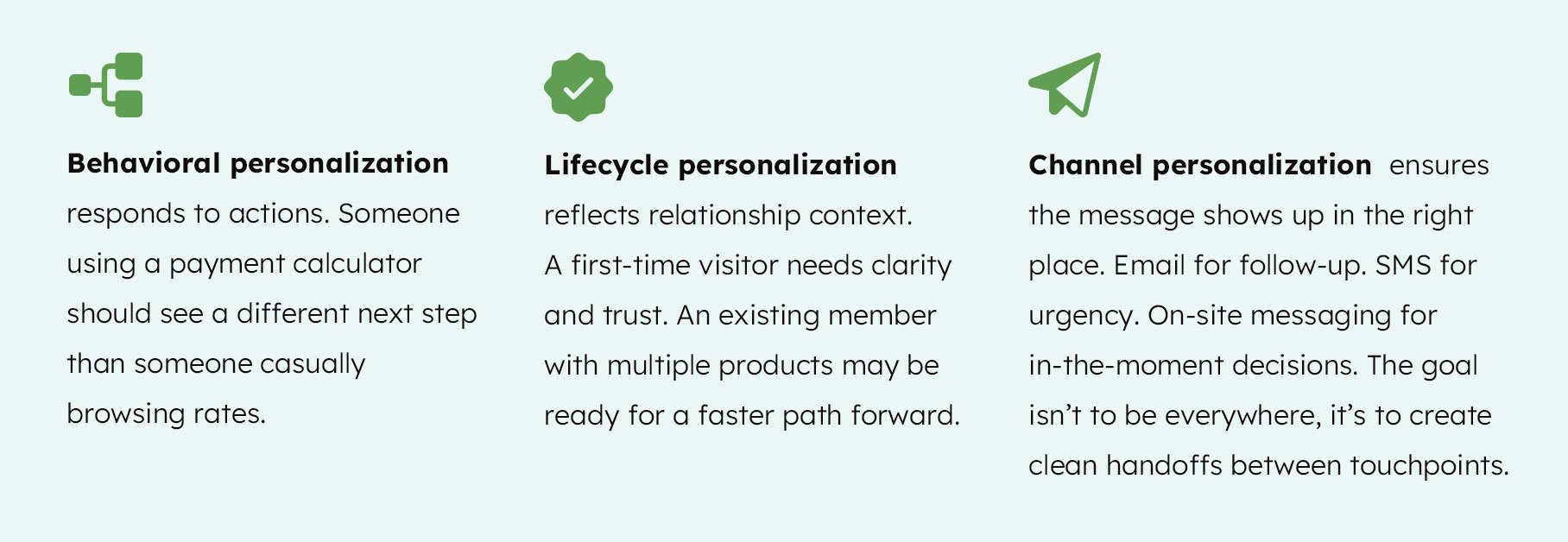
Personalization becomes effective when it reflects what someone is doing, not just who they are.
The Strategies That Drive Online Application Conversion
Across banks and credit unions, a few approaches consistently improve conversion:
Application Recovery
Many users who start applications don’t finish, not because they’ve opted out, but because they’ve paused. Timely follow-ups, saved progress, and direct return links recover a meaningful portion of that volume. This applies equally to loan applications and deposit account openings.
Behavior-based Messaging
A user who engaged deeply (calculator, rate comparison, repeat visits) should not receive the same message as a first-time visitor. Matching outreach to behavior increases relevance and response.
Product-specific Journeys
Mortgage journeys require more education, reassurance, and milestone-based communication regarding the onboarding process, especially when addressing a specific question. Auto loans move faster and benefit from speed and tight alignment with the buying process. Deposit account openings sit somewhere in between: they're lower commitment than a loan, but they're still a relationship decision, and the follow-up should treat them that way.
A credit union running an auto loan campaign that segments follow-up by behavior (triggering one message for someone who used a payment calculator and a different one for someone who only checked a rate) consistently sees higher completion from the calculator segment. That single distinction, acted on, often determines whether the application happens.
The same logic applies to deposit campaigns. A credit union promoting a high-yield savings account can use core data to exclude members who already hold that product, then use behavioral signals to prioritize follow-up for visitors who returned to the rates page more than once in a week. That combination keeps the campaign from cannibalizing existing relationships while focusing outreach on the members most likely to open a new account.
The Technology Behind Financial Services Personalization
Personalization at this level depends on two data layers working together, and most institutions have both but haven't connected them.
The first is behavioral data: what someone is doing right now. Which pages they've visited. Whether they used a payment calculator or just browsed a rate table. Whether they started an application and stopped at field five. A CRM and marketing platform like HubSpot captures all of this alongside your online application platforms, and it's the layer most institutions underutilize.
The second is relationship data: what you already know about them from your core system. How long they've been a member. What products they hold. Whether they have an existing loan in good standing or none at all.
Neither layer alone gets you there. Behavioral signals without relationship context mean you're treating a 12-year member with a mortgage the same as a cold prospect who found a rate comparison on Google. Relationship context without behavioral signals means you're running segmented campaigns against static data and missing the moment when someone is actually ready to act.

When a core banking integration connects the two, the picture changes. You're not just responding to what someone is doing. You're responding to what it means given who they are.
Three examples of what that looks like in practice:
- A member with no current loan who runs the auto loan calculator three times in a week already qualifies for your loan origination member rate and likely trusts you, which is vital for securing new business. That's a fundamentally different conversation than a prospect with no prior relationship doing the same thing. The message should reflect that.
- A member with a CD maturing in 30 days who starts visiting your high-yield savings page is a retention and deposit conversion opportunity sitting in your existing book, especially when considering suitable loan products. Without the core data, you'd never know the CD was maturing. Without the behavioral signal, you wouldn't know they were actively evaluating options in their digital experience.
- A prospect who gets 80% through a deposit account application and abandons is a friction problem, not a product problem. The recovery message is about reducing barriers and building trust, which can help decrease abandonment rates, not upselling something they don't have yet.
This is why the integration is the work. HubSpot doesn't replace your core banking system. What it does is give you a connected place to act on the combination: the right message, at the right moment, for the right person, based on what they're doing and what you already know about them.
The institutions getting this right aren't necessarily running more sophisticated technology. They've done the integration work that most haven't gotten around to. That's the actual gap.
Measuring Success and Where Personalization Breaks Down
Even well-designed personalization strategies break down in execution. Two problems come up more than any others: personalization that feels intrusive rather than helpful, and disconnected systems that deliver contradictory experiences across channels. Both are solvable. Neither gets fixed without someone owning the integration work and monitoring it over time, ensuring that users can easily open accounts, while keeping the number of pages to a minimum, and that monitoring starts with measuring the right things.
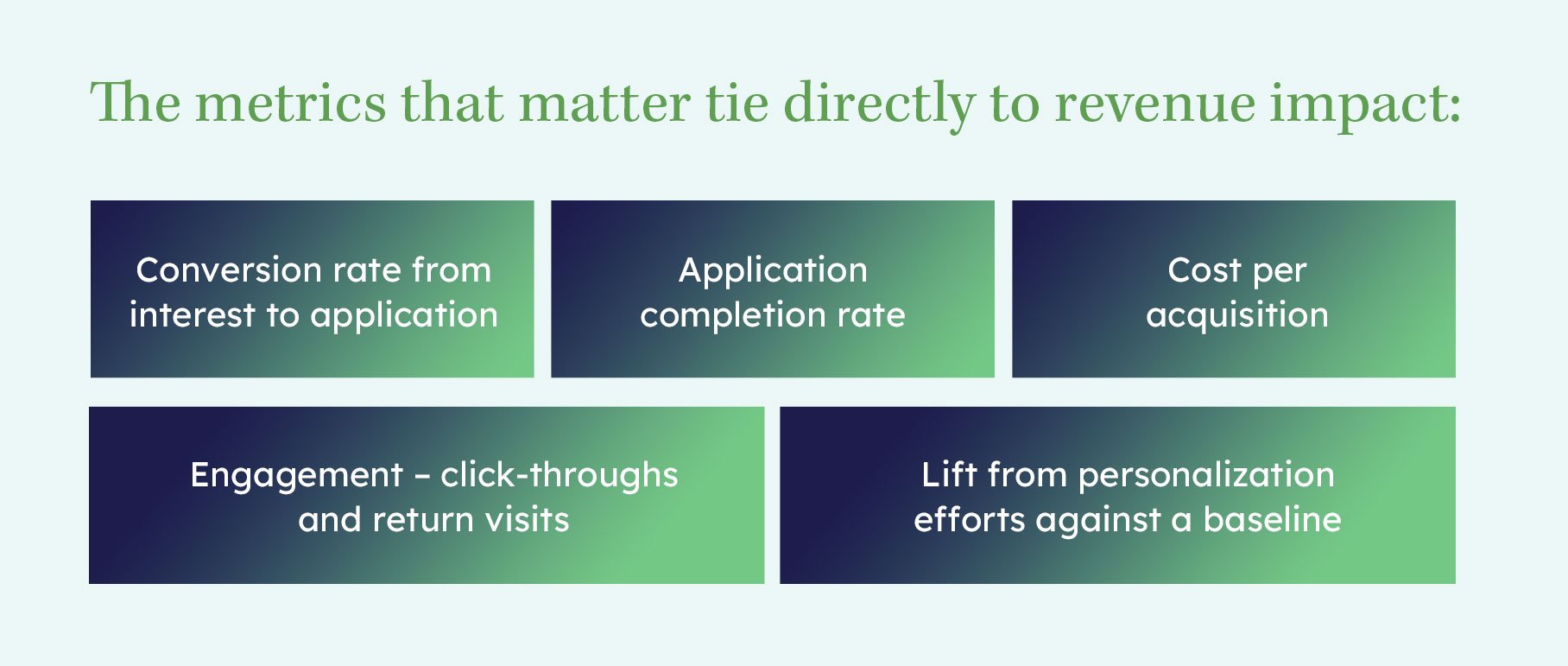
Vanity metrics will tell you the campaign ran. These metrics will tell you whether it worked. Tracking them consistently is what separates personalization as a concept from personalization as an operating advantage.
The goal throughout isn't to prove how much you know about a member or customer. It's to make the next step easy enough that they take it.
How GreenHouse Agency Helps Financial Institutions Close the Gap
If your current setup can't tell you which campaign drove last quarter's loan applications or deposit account openings, that's the starting point. The path from interest to application will always have friction. But institutions that act on intent, rather than just observing it, are the ones converting it.
GreenHouse Agency enables your team to drive impact
GreenHouse Agency specializes in financial institutions (credit unions and community banks), helping them build the HubSpot infrastructure that makes personalization operational, not theoretical.
That includes mapping your actual member and customer journey, activating the data you already have, and building automation that runs without requiring a full-time ops team.
